
|
You entered: light
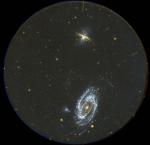 M81 and M82: GALEX Full Field
30.12.2004
Intriguing galaxy pair M81 and M82 shine in this full-field view from the orbiting GALEX observatory. GALEX - the Galaxy Evolution Explorer - scans the cosmos in ultraviolet light, a view that follows star formation and galaxy evolution through the Universe.
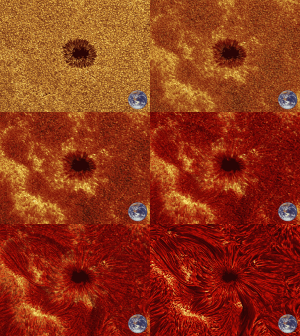 Sunspot Metamorphosis: From Bottom to Top
16.02.2005
Sunspots -- magnets the size of the Earth -- are normally seen flat on the Sun. The above digital metamorphosis, however, shows a sunspot as it appears at increasing heights, effectively in three dimensions. The above...
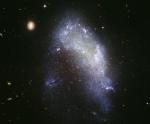 NGC 1427A: Galaxy in Motion
4.03.2005
In this tantalizing image, young blue star clusters and pink star-forming regions abound in NGC 1427A, a galaxy in motion. The small irregular galaxy's swept back outline points toward the top of this...
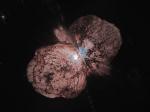 Doomed Star Eta Carinae
26.03.2006
Eta Carinae may be about to explode. But no one knows when - it may be next year, it may be one million years from now. Eta Carinae's mass - about 100 times greater than our Sun - makes it an excellent candidate for a full blown supernova.
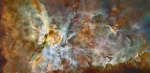 Carina Nebula Panorama from Hubble
24.05.2009
In one of the brightest parts of Milky Way lies a nebula where some of the oddest things occur. NGC 3372, known as the Great Nebula in Carina, is home to massive stars and changing nebula.
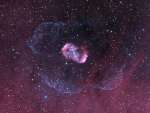 A Halo for NGC 6164
27.10.2012
Beautiful emission nebula NGC 6164 was created by a rare, hot, luminous O-type star, some 40 times as massive as the Sun. Seen at the center of the cosmic cloud, the star is a mere 3 to 4 million years old.
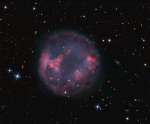 Planetary Nebula Abell 7
5.12.2013
Very faint planetary nebula Abell 7 is some 1,800 light-years distant, just south of Orion in planet Earth's skies in the constellation Lepus, The Hare. Surrounded by Milky Way stars and near...
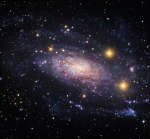 NGC 3621: Far Beyond the Local Group
24.02.2017
Far beyond the local group of galaxies lies NGC 3621, some 22 million light-years away. Found in the multi-headed southern constellation Hydra, the winding spiral arms of this gorgeous island universe are loaded with luminous blue star clusters, pinkish starforming regions, and dark dust lanes.
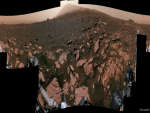 Ancient Ogunquit Beach on Mars
8.05.2017
This was once a beach -- on ancient Mars. The featured 360-degree panorama, horizontally compressed, was taken by the robotic Curiosity rover currently exploring the red planet. Named Ogunquit Beach after its terrestrial counterpart, evidence...
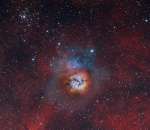 Composite Messier 20 and 21
28.06.2017
The beautiful Trifid Nebula, also known as Messier 20, lies about 5,000 light-years away, a colorful study in cosmic contrasts. It shares this nearly 1 degree wide field with open star cluster Messier 21 (top left).
|
January February March April May June July August September October |
|||||||||||||||||||||||||||||||||||||||||||||||||