
|
You entered: light
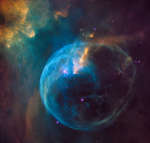 NGC 7635: The Bubble Nebula
22.04.2016
Blown by the wind from a massive star, this interstellar apparition has a surprisingly familiar shape. Cataloged as NGC 7635, it is also known simply as The Bubble Nebula. Although it looks delicate, the 7 light-year diameter bubble offers evidence of violent processes at work.
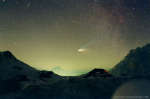 Comet Hale Bopp Over Val Parola Pass
9.04.2017
Comet Hale-Bopp, the Great Comet of 1997, became much brighter than any surrounding stars. It was seen even over bright city lights. Away from city lights, however, it put on quite a spectacular show. Here Comet Hale-Bopp was photographed above Val Parola Pass in the Dolomite mountains surrounding Cortina d'Ampezzo, Italy.
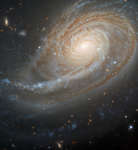 Arp 78: Peculiar Galaxy in Aries
24.03.2022
Peculiar spiral galaxy Arp 78 is found within the boundaries of the head strong constellation Aries. Some 100 million light-years beyond the stars and nebulae of our Milky Way galaxy, the island universe is over 100,000 light-years across.
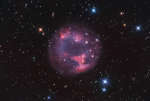 Planetary Nebula Abell 7
21.05.2022
Very faint planetary nebula Abell 7 is some 1,800 light-years distant, just south of Orion in planet Earth's skies in the constellation Lepus, The Hare. Surrounded by Milky Way stars and near...
 Webb s Rho Ophiuchi
13.07.2023
A mere 390 light-years away, Sun-like stars and future planetary systems are forming in the Rho Ophiuchi molecular cloud complex, the closest star-forming region to our fair planet. The James Webb Space Telescope's NIRCam peered into the nearby natal chaos to capture this infrared image at an inspiring scale.
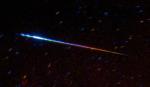 A Perseid Meteor
12.08.2000
This weekend, the annual Perseid Meteor Shower reaches its maximum. Grains of cosmic sand and gravel shed from Comet Swift-Tuttle will streak across the sky as they vaporize during entry into Earth's atmosphere. The Perseids result from the yearly
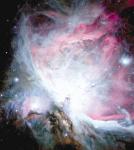 The Orion Nebula from CFHT
15.03.2004
Few astronomical sights excite the imagination like the nearby stellar nursery known as the Orion Nebula. The Nebula's glowing gas surrounds hot young stars at the edge of an immense interstellar molecular cloud only 1500 light-years away.
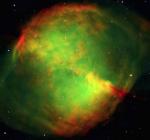 M27: Not A Comet
23.10.1999
While searching the skies above 18th century France for comets, astronomer Charles Messier diligently recorded this object as number 27 on his list of things which are definitely not comets. So what is it?
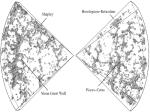 The Sloan Great Wall: Largest Known Structure
7.11.2007
What is the largest structure known? The answer might depend on how one defines "structure." A grouping of galaxies known as the Sloan Great Wall was discovered in the Sloan Digital Sky Survey and is a leading candidate.
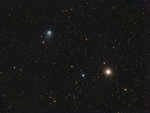 Comet Garradd and Messier 15
6.08.2011
Recorded on August 2, this telescopic composite image catches Comet Garradd (C/2009 P1) in the same field of view as globular star cluster M15. The celestial scene would have been a rewarding one for influential 18th century comet hunter Charles Messier.
|
January February March April May June July August September October |
|||||||||||||||||||||||||||||||||||||||||||||||||