
|
You entered: light
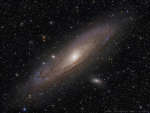 Andromeda Island Universe
30.04.2020
The most distant object easily visible to the unaided eye is M31, the great Andromeda Galaxy some two and a half million light-years away. But without a telescope, even this immense spiral galaxy - spanning over 200,000 light years - appears as a faint, nebulous cloud in the constellation Andromeda.
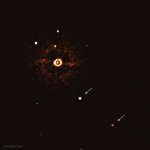 APOD: 2020 August 18 Б TYC 8998 760 1: Multiple Planets around a Sun Like Star
18.08.2020
Do other stars have planets like our Sun? Previous evidence shows that they do, coming mostly from slight shifts in the star's light created by the orbiting planets. Recently, however, and for the first time, a pair of planets has been directly imaged around a Sun-like star.
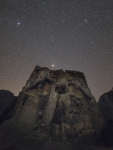 Mars, Pleiades, and Andromeda over Stone Lions
13.10.2020
Three very different -- and very famous -- objects were all captured in a single frame last month. On the upper left is the bright blue Pleiades, perhaps the most famous cluster of stars on the night sky. The Pleiades (M45) is about 450 light years away and easily found a few degrees from Orion.
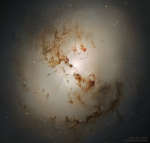 Central NGC 1316: After Galaxies Collide
26.01.2021
How did this strange-looking galaxy form? Astronomers turn detectives when trying to figure out the cause of unusual jumbles of stars, gas, and dust like NGC 1316. Inspection indicates that NGC 1316 is an enormous elliptical galaxy that somehow includes dark dust lanes usually found in a spiral galaxy.
 APOD: 2024 May 1 Б IC 1795: The Fishhead Nebula
1.05.2024
To some, this nebula looks like the head of a fish. However, this colorful cosmic portrait really features glowing gas and obscuring dust clouds in IC 1795, a star forming region in the northern constellation Cassiopeia.
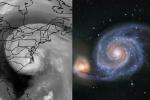 Logarithmic Spirals Isabel and M51
25.09.2003
Uncomfortably close hurricane Isabel (left) and 30 million light-year distant galaxy M51 actually don't have much in common. For starters, Isabel was hundreds of miles across, while M51 (the Whirlpool Galaxy) spans about...
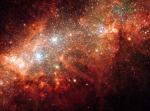 NGC 1569: Starburst in a Small Galaxy
5.02.2004
Grand spiral galaxies often seem to get all the glory, flaunting their young, bright, blue star clusters in beautiful, symmetric spiral arms. But small, irregular galaxies form stars too. In fact, as pictured here...
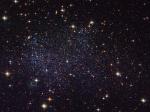 Sagittarius Dwarf Irregular Galaxy
16.11.2004
How old is this galaxy? The nearby Local Group galaxy dubbed the Sagittarius Dwarf Irregular Galaxy (SagDIG) is not only very small but also has relatively few elements more massive than helium.
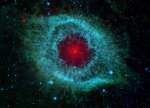 Dust and the Helix Nebula
31.12.2009
Dust makes this cosmic eye look red. The eerie Spitzer Space Telescope image shows infrared radiation from the well-studied Helix Nebula (NGC 7293) a mere 700 light-years away in the constellation Aquarius.
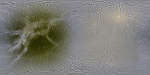 The Map of Dione
6.11.2014
This cylindrical projection global map is one of six new color maps of Saturn's midsized icy moons, constructed using 10 years of image data from the Cassini spacecraft. Discovered by Cassini (the astronomer) in 1684, Dione is about 1,120 kilometers across.
|
January February March April May June July August September October |
|||||||||||||||||||||||||||||||||||||||||||||||||