
|
You entered: light
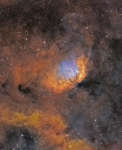 The Tulip in the Swan
14.11.2014
Framing a bright emission region this telescopic view looks out along the plane of our Milky Way Galaxy toward the nebula rich constellation Cygnus the Swan. Popularly called the Tulip Nebula the glowing cloud of interstellar gas and dust is also found in the 1959 catalog by astronomer Stewart Sharpless as Sh2-101.
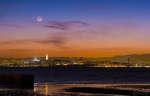 Mercury and Crescent Moon Set
15.04.2016
Innermost planet Mercury and a thin crescent Moon are never found far from the Sun in planet Earth's skies. Taken near dusk on April 8, this colorful evening skyscape shows them both setting toward the western horizon just after the Sun.
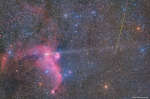 Meteor, Comet, and Seagull (Nebula)
21.10.2018
A meteor, a comet, and a photogenic nebula have all been captured in this single image. The closest and most fleeting is the streaking meteor on the upper right -- it was visible for less than a second.
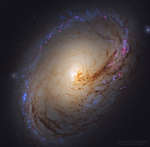 Spiral Galaxy M96 from Hubble
12.06.2019
Dust lanes seem to swirl around the core of Messier 96 in this colorful, detailed portrait of the center of a beautiful island universe. Of course M96 is a spiral galaxy, and counting...
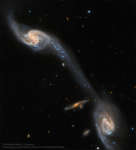 Galaxies: Wilds Triplet from Hubble
8.11.2022
How many galaxies are interacting here? This grouping of galaxies is called the Wild Triplet, not only for the discoverer, but for the number of bright galaxies that appear. It had been assumed that...
 APOD: 2024 August 21 Б Fermis 12 year All Sky Gamma ray Map
21.08.2024
Forget X-ray vision Б imagine what you could see with gamma-ray vision! The featured all-sky map shows what the universe looks like to NASA's Fermi Gamma-ray Space Telescope. Fermi sees light with energies about a billion times what the human eye can see, and the map combines 12 years of Fermi observations.
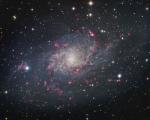 M33: Spiral Galaxy in Triangulum
24.09.2003
The small constellation Triangulum in the northern sky harbors this magnificent face-on spiral galaxy, M33. Its popular names include the Pinwheel Galaxy or just the Triangulum Galaxy. M33's diameter spans over 50,000 light-years, making it third largest in the Local Group of galaxies after the Andromeda Galaxy (M31), and our own Milky Way.
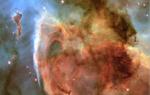 Colorful Clouds Of Carina
3.02.2000
Tumultuous clouds of the Carina Nebula, 8000 light-years away, glow in planet Earth's southern sky. Striking and detailed, this close-up of a portion of the famous nebula is a combination of exposures through six different filters taken with the Hubble Space Telescope's Wide Field Planetary Camera 2 in April of 1999.
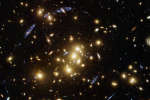 Giant Cluster Bends, Breaks Images
23.08.2009
What are those strange blue objects? Many of the brightest blue images are of a single, unusual, beaded, blue, ring-like galaxy which just happens to line-up behind a giant cluster of galaxies. Cluster galaxies here typically appear yellow and -- together with the cluster's dark matter -- act as a gravitational lens.
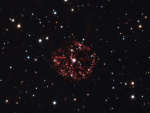 GK Per: Nova of 1901
5.11.2011
Early in the 20th century, GK Persei briefly became one of the brightest stars in planet Earth's sky, an event known as Nova Persei 1901. Documented in this modern day composite of two images from 2003 and 2011 the ejecta from the explosion, popularly called the Firework Nebula, continues to expand into space.
|
January February March April May June July August September October |
|||||||||||||||||||||||||||||||||||||||||||||||||