
|
You entered: light
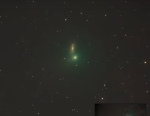 Comet Iwamoto Before Spiral Galaxy NGC 2903
18.02.2019
It isn't every night that a comet passes a galaxy. Last Thursday, though, binocular comet C/2018 Y1 (Iwamoto) moved nearly in front of a spiral galaxy of approximately the same brightness: NGC 2903. Comet Iwamoto was discovered late last year and orbits the Sun in a long ellipse.
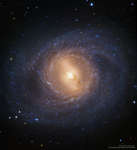 M95: Spiral Galaxy with an Inner Ring
28.05.2019
Why do some spiral galaxies have a ring around the center? First and foremost, M95 is one of the closer examples of a big and beautiful barred spiral galaxy. Visible in the featured combination...
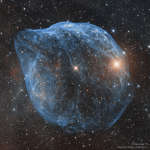 Sharpless 308: The Dolphin Nebula
1.03.2020
Blown by fast winds from a hot, massive star, this cosmic bubble is much larger than the dolphin it appears to be. Cataloged as Sharpless 2-308 it lies some 5,200 light-years away toward the constellation of the Big Dog (Canis Major) and covers slightly more of the sky than a Full Moon.
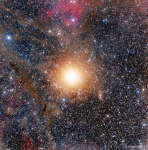 Behind Betelgeuse
10.05.2020
What's behind Betelgeuse? One of the brighter and more unusual stars in the sky, the red supergiant star Betelgeuse can be found in the direction of famous constellation Orion. Betelgeuse, however, is actually...
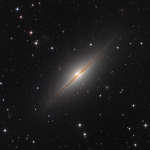 NGC 7814: Little Sombrero with Supernova
21.07.2021
Point your telescope toward the high flying constellation Pegasus and you can find this expanse of Milky Way stars and distant galaxies. NGC 7814 is centered in the pretty field of view that would almost be covered by a full moon.
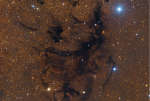 LDN 673: Dark Clouds in Aquila
28.10.2022
Part of a dark expanse that splits the crowded plane of our Milky Way galaxy, the Aquila Rift arcs through planet Earth's skies near bright star Altair. In eerie silhouette against the Milky...
 APOD: 2025 February 3 Б Wolf Rayet Star 124: Stellar Wind Machine
2.02.2025
Some stars explode in slow motion. Rare, massive Wolf-Rayet stars are so tumultuous and hot that they are slowly disintegrating right before our telescopes. Glowing gas globs each typically over 30 times more massive than the Earth are being expelled by violent stellar winds.
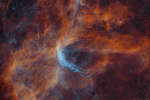 APOD: 2026 May 22 Б The Nebulous Realm of WR 134
21.05.2026
This cosmic snapshot covers a field of view over twice as wide as the full Moon within the boundaries of the high-flying constellation Cygnus. Made using astronomical narrowband filters, the image highlights the bright edge of a ring-like nebula traced by the glow of ionized hydrogen and oxygen gas.
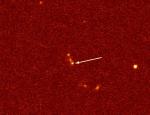 Gamma Ray Burst Afterglow: Supernova Connection
5.04.2002
What causes the mysterious gamma-ray bursts? Indicated in this Hubble Space Telescope exposure of an otherwise unremarkable field in the constellation Crater, is the dwindling optical afterglow of a gamma-ray burst first detected by the Beppo-SAX satellite on 2001 December 11.
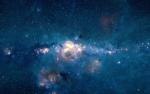 Journey to the Center of the Galaxy
25.10.2002
In Jules Verne's science fiction classic A Journey to the Center of the Earth, Professor Hardwigg and his fellow explorers encounter many strange and exciting wonders. What wonders lie at the center of our Galaxy?
|
January February March April May June July August September October |
|||||||||||||||||||||||||||||||||||||||||||||||||