
|
You entered: light
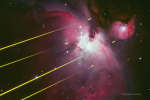 Nebula with Laser Beams
29.03.2017
Four laser beams cut across this startling image of the Orion Nebula, as seen from ESO's Paranal Observatory in the Atacama desert on planet Earth. Not part of an interstellar conflict, the lasers...
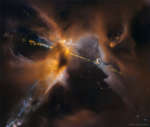 Duel Particle Beams in Herbig Haro 24
11.03.2018
This might look like a double-bladed lightsaber, but these two cosmic jets actually beam outward from a newborn star in a galaxy near you. Constructed from Hubble Space Telescope image data, the stunning scene...
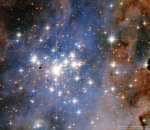 Young Star Cluster Trumpler 14 from Hubble
14.05.2019
Why does star cluster Trumpler 14 have so many bright stars? Because it is so young. Many cluster stars have formed only in the past 5 million years and are so hot they emit detectable X-rays.
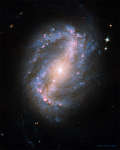 Barred Spiral Galaxy NGC 6217
21.02.2022
Many spiral galaxies have bars across their centers. Even our own Milky Way Galaxy is thought to have a modest central bar. Prominently barred spiral galaxy NGC 6217, featured here, was captured in spectacular detail in this image taken by the Advanced Camera for Surveys on the orbiting Hubble Space Telescope in 2009.
 APOD: 2025 November 30 Б The Surface of Titan from Huygens
30.11.2025
If you could stand on Titan -- what would you see? The featured color viewa from Titan gazes across an unfamiliar and distant landscape on Saturn's largest moon. The scene was recorded by ESA's Huygens probe in 2005 after a 2.5-hour descent through a thick atmosphere of nitrogen laced with methane.
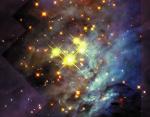 The Brown Dwarfs of Orions Trapezium
30.08.2000
The bright stars above are well known as heart of the Trapezium, an open cluster of stars in the center of the Orion Nebula. The many dim objects, however, are not well known, and have come to attention only on recent images in infrared light.
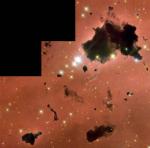 Thackeray's Globules
8.01.2002
Rich star fields and glowing hydrogen gas silhouette dense, opaque clouds of interstellar gas and dust in this Hubble Space Telescope close-up of IC 2944, a bright star forming region in Centaurus, 5,900 light-years away. The largest of these dark globules, first spotted by South African astronomer A. D.
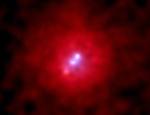 3C 295: X-rays From A Giant Galaxy
25.11.1999
Did this galaxy eat too much? Five billion light-years away, the giant elliptical galaxy 3C295 is a prodigious source of energy at radio wavelengths. Bright knots of X-ray emission are also seen at the center of this false-color Chandra Observatory image of the region.
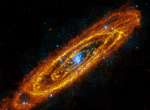 The Once and Future Stars of Andromeda
20.01.2011
The big, beautiful Andromeda Galaxy, aka M31, is a spiral galaxy a mere 2.5 million light-years away. Two space-based observatories have combined to produce this intriguing composite image of Andromeda, at wavelengths outside the visible spectrum. The remarkable view follows the locations of this galaxy's once and future stars.
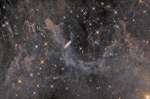 Galaxies, Stars, and Dust
13.10.2012
Spiky stars and spooky shapes abound in this deep cosmic skyscape. Its well-composed field of view covers about 2 Full Moons on the sky toward the constellation Pegasus. Of course the brighter stars show diffraction spikes, the commonly seen effect of internal supports in reflecting telescopes, and lie well within our own Milky Way galaxy.
|
January February March April May June July August September October |
|||||||||||||||||||||||||||||||||||||||||||||||||