
|
You entered: NASA
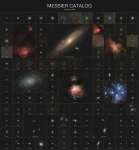 APOD: 2026 May 14 Б The Messier Catalog at Uniform Scale
13.05.2026
What are some of the most interesting astronomical objects you can see in the night sky? Armed with a good pair of binoculars or a small telescope, if you live in the Northern Hemisphere, you can look for the very popular objects in the Messier Catalog.
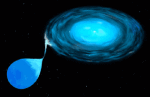 Accretion Disk Binary System
25.12.1995
Our Sun is unusual in that it is alone - most stars occur in multiple or binary systems. In a binary system, the higher mass star will evolve faster and will eventually become a compact object - either a white dwarf star, a neutron star, or black hole.
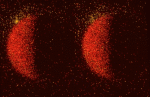 X-ray Moon and X-ray Star
26.02.1996
An X-ray star winks out behind the Moon in these before and after views of a lunar occultation of the galactic X-ray source designated GX5-1. The false color images were made using data...
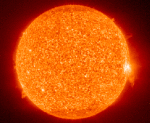 Helios Helium
20.05.1996
Above is an image of the relatively quiet Sun made on May 18 in light emitted by ionized Helium atoms in the Solar chromosphere. Helium was first discovered in the Sun in 1868, its name fittingly derived from from the Greek word Helios, meaning Sun. Credit for the discovery goes to astronomer Joseph Lockyer.
 Sojourner's View: The Sagan Memorial Station
10.07.1997
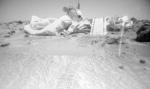
The robot rover Sojourner sees Mars from the perspective of a house cat. During the 7 month cruise to Mars aboard the Pathfinder spacecraft, Sojourner measured only seven inches tall in a stowed position but prowling the martian landscape it has stretched to its full height of 1 foot (30 centimeters).
 X-Ray Pleiades
5.04.1998
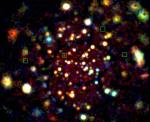
The Pleiades star cluster is one of the jewels of the northern sky. To the unaided eye it appears as a lovely and tantalizing grouping of stars in the constellation of Taurus, while telescopic views reveal cluster stars surrounded by delicate blue wisps of dust-reflected starlight.
 The High Energy Crab Nebula
21.11.1998
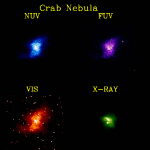
This is the mess that is left when a star explodes. The Crab Nebula is so energetic that it glows in every kind of light known. Shown above are images of the Crab Nebula from visible light to the X-ray band.
 Lunar Close Up
11.02.1999
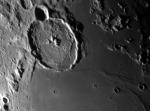
Late last month, NASA's Lunar Prospector spacecraft moved in for a closer look at the Moon. Now entering an extended mission phase, controllers have reduced the altitude of this polar lunar orbiter from 100 kilometers to about 30 kilometers (18 miles).
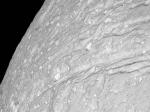 Cratered Cliffs of Ice on Saturns Tethys
12.10.2005
The surface of Saturn's moon Tethys is riddled with icy cliffs and craters. The most detailed images ever taken of Tethys were captured late last month as the robot Cassini spacecraft swooped past the frozen ice moon.
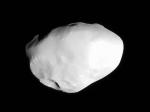 An Unusually Smooth Surface on Saturns Telesto
21.02.2006
Why is Saturn's small moon Telesto so smooth? Possibly Telesto is covered with a type of granular icy material similar to that suspected of covering Pandora, another of Saturn's small moon's. If so, Telesto might be more like a pile of rubble than a solid body.
|
January February March April May June July August September October |
|||||||||||||||||||||||||||||||||||||||||||||||||