
|
You entered: NASA
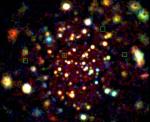 X-Ray Pleiades
28.08.1999
The Pleiades star cluster is one of the jewels of the northern sky. To the unaided eye it appears as an alluring group of stars in the constellation Taurus, while telescopic views reveal cluster stars surrounded by delicate blue wisps of dust-reflected starlight.
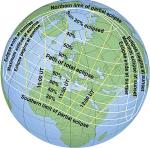 A Total Eclipse for Europe
10.08.1999
The last total solar eclipse of this millennium will be visible for a few minutes tomorrow from a narrow path in Europe and Asia. There, millions of sightseers will witness the Moon move directly between the Earth and Sun, covering up the Sun completely.
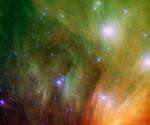 Seven Dusty Sisters
13.04.2007
Hurtling through a cosmic dust cloud a mere 400 light-years away, the lovely Pleiades or Seven Sisters star cluster is well-known in astronomical images for its striking blue reflection nebulae. At visible wavelengths...
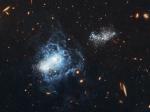 I Zwicky 18: The Case of the Aging Galaxy
17.10.2007
How old is this galaxy? The galaxy on the left, I Zwicky 18, was once thought to be one of the youngest galaxies on record since its bright stars indicated an age of only 500 million years.
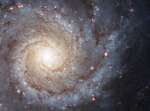 M74: The Perfect Spiral
1.12.2007
If not perfect, then this spiral galaxy is at least one of the most photogenic. An island universe of about 100 billion stars, 32 million light-years away toward the constellation Pisces, M74 presents a gorgeous face-on view.
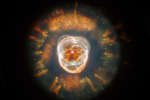 The Eskimo Nebula from Hubble
3.05.2009
In 1787, astronomer William Herschel discovered the Eskimo Nebula. From the ground, NGC 2392 resembles a person's head surrounded by a parka hood. In 2000, the Hubble Space Telescope imaged the Eskimo Nebula. From space, the nebula displays gas clouds so complex they are not fully understood.
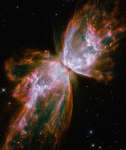 The Butterfly Nebula from Upgraded Hubble
10.09.2009
The bright clusters and nebulae of planet Earth's night sky are often named for flowers or insects, and NGC 6302 is no exception. With an estimated surface temperature of about 250,000 degrees...
 A Mars Panorama from the Phoenix Lander
13.03.2011
If you could stand on Mars, what would you see? The robotic Phoenix spacecraft that landed on Mars in 2008 recorded the above spectacular panorama. The above image is actually a digital combination of over 100 camera pointings and surveys fully 360 degrees around the busy robotic laboratory.
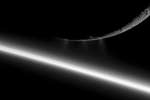 Enceladus Looms
12.05.2011
A sunlit crescent of Saturn's moon Enceladus looms above the night side of Saturn in this dramatic image from the Cassini spacecraft. Captured on August 13, 2010 looking in a sunward direction during...
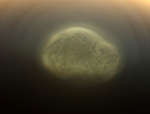 South Polar Vortex Discovered on Titan
24.07.2012
What's happening over the south pole of Titan? A vortex of haze appears to be forming, although no one is sure why. The above natural-color image shows the light-colored feature. The vortex was found on images taken last month when the robotic Cassini spacecraft flew by the unusual atmosphere-shrouded moon of Saturn.
|
January February March April May June July August September October |
|||||||||||||||||||||||||||||||||||||||||||||||||