
|
You entered: NASA
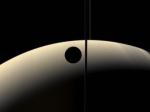 Crescent Rhea Occults Crescent Saturn
11.07.2006
Soft hues, partially lit orbs, a thin trace of the ring, and slight shadows highlight this understated view of the majestic surroundings of the giant planet Saturn. Looking nearly back toward the Sun, the robot Cassini spacecraft now orbiting Saturn captured crescent phases of Saturn and its moon Rhea in color a few months ago.
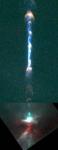 HH111's 12 Light-Year Star Jet
20.03.2000
The complex interactions of three stars in the Orion B molecular cloud complex have resulted in the ejection of particles along a 12 light-year long jet. One of the stars in the HH111 system has apparently also been ejected leaving two stars tightly bound in a binary orbit.
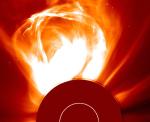 Sun Storm: A Coronal Mass Ejection
8.03.2000
Late last month another erupting filament lifted off the active solar surface and blasted this enormous bubble of magnetic plasma into space. Direct light from the sun is blocked in this picture of the event with the sun's relative position and size indicated by a white half circle at bottom center.
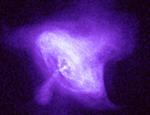 The Crab Nebula in X Rays
29.09.1999
Why does the Crab Nebula still glow? In the year 1054 A.D. a supernova was observed that left a nebula that even today glows brightly in every color possible, across the entire electromagnetic spectrum. At the nebula's center is an ultra-dense neutron star that rotates 30 times a second.
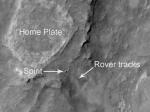 Spirit Rover on Mars Imaged from Orbit
5.12.2006
If you have the right equipment, you can see the Spirit rover currently rolling across Mars. The right equipment, however, is currently limited to the High Resolution Imaging Science Experiment onboard the Mars Reconnaissance Orbiter (MRO). MRO arrived at Mars in March and just started science observations of the red planet last month.
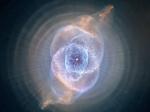 The Cats Eye Nebula from Hubble
13.05.2007
Staring across interstellar space, the alluring Cat's Eye nebula lies three thousand light-years from Earth. A classic planetary nebula, the Cat's Eye (NGC 6543) represents a final, brief yet glorious phase in the life of a sun-like star.
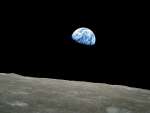 Earthrise
23.12.2008
Forty years ago, in December of 1968, the Apollo 8 crew flew from the Earth to the Moon and back again. Frank Borman, James Lovell, and William Anders were launched atop a Saturn V rocket on December 21, circled the Moon ten times in their command module, and returned to Earth on December 27.
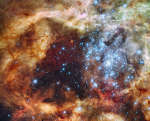 Star Cluster R136 Bursts Out
20.12.2009
In the center of star-forming region 30 Doradus lies a huge cluster of the largest, hottest, most massive stars known. These stars, known collectively as star cluster R136, were captured above in visible light by the newly installed Wide Field Camera peering though the recently refurbished Hubble Space Telescope.
 It Came from the Sun
18.10.2010
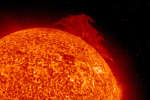
What's that coming over the edge of the Sun? What might appear at first glance to be some sort of Sun monster is actually a solar prominence. The above prominence, captured...
 Saturns Hyperion: A Moon with Odd Craters
26.02.2011
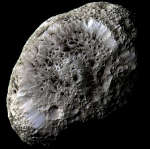
What lies at the bottom of Hyperion's strange craters? Nobody's sure. To help find out, the robot Cassini spacecraft now orbiting Saturn swooped past the sponge-textured moon in 2005 and 2010 and took images of unprecedented detail.
|
January February March April May June July August September October |
|||||||||||||||||||||||||||||||||||||||||||||||||