
|
You entered: dark
 A Year of Sky on Earth
24.07.2013
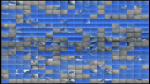
Each panel shows one day. With 360 movie panels, the sky over (almost) an entire year is shown in time lapse format as recorded by a video camera on the roof of the Exploratorium museum in San Francisco, California.
 Layered Hills on Mars
24.12.2003
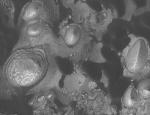
Why are some hills on Mars so layered? The answer is still under investigation. Clearly, dark windblown sand surrounds outcropping of light sedimentary rock across the floor of crater Arabia Terra. The light rock clearly appears structured into many layers, the lowest of which is likely very old.
 Orions Horsehead Nebula
21.03.2005
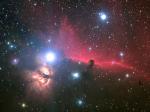
The Horsehead Nebula is one of the most famous nebulae on the sky. It is visible as the dark indentation to the red emission nebula seen above and to the right of center in the above photograph. The bright star on the left is located in the belt of the familiar constellation of Orion.
 Orion in Gas, Dust, and Stars
10.11.2014
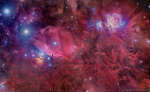
The constellation of Orion holds much more than three stars in a row. A deep exposure shows everything from dark nebula to star clusters, all embedded in an extended patch of gaseous wisps in the greater Orion Molecular Cloud Complex.
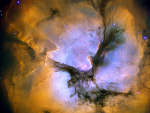 In the Center of the Trifid Nebula
30.06.2008
Clouds of glowing gas mingle with lanes of dark dust in the Trifid Nebula, a star forming region toward the constellation of Sagittarius. In the center, the three huge dark dust lanes that give the Trifid its name all come together.
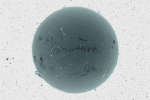 Black Sun and Inverted Starfield
15.10.2012
Does this strange dark ball look somehow familiar? If so, that might be because it is our Sun. In the above image, a detailed solar view was captured originally in a very specific color of red light, then rendered in black and white, and then color inverted.
 APOD: 2023 June 26 Б The Belt of Venus over Mount Everest
26.06.2023
You've surely seen it, but you might not have noticed it. During a cloudless twilight, just before sunrise or after sunset, part of the atmosphere above the horizon appears slightly dark and off-color.
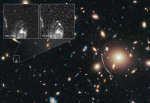 Galaxy Cluster Magnifies Distant Supernova
5.05.2014
How do you calibrate a huge gravitational lens? In this case the lens is the galaxy cluster Abell 383, a massive conglomeration of galaxies, hot gas, and dark matter that lies about 2.5 billion light years away (redshift z=0.187).
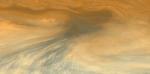 Jupiter's Dry Spots
12.06.1997
Known for its spectacular images of Jupiter's moons, Io, Ganymede, Callisto, and Europa, the robot spacecraft Galileo has also aggressively explored the Jovian atmosphere. In December of 1995, Galileo's atmospheric probe descended into Jupiter's clouds and reported a surprising absence of water.
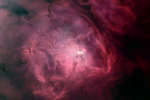 Gas and Dust of the Lagoon Nebula
15.07.2008
This beautiful cosmic cloud is a popular stop on telescopic tours of the constellation Sagittarius. Eighteenth century cosmic tourist Charles Messier cataloged the bright nebula as M8, while modern day astronomers recognize the Lagoon...
|
January February March April May June July August September |
|||||||||||||||||||||||||||||||||||||||||||||||||