
|
You entered: dark
 APOD: 2024 November 25 Б The Horsehead Nebula
25.11.2024
One of the most identifiable nebulas in the sky, the Horsehead Nebula in Orion, is part of a large, dark, molecular cloud. Also known as Barnard 33, the unusual shape was first discovered on a photographic plate in the late 1800s.
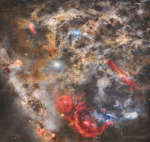 APOD: 2026 March 2 Б The Dusty Surroundings of Orion and the Pleiades
2.03.2026
How well do you know the night sky? OK, but how well can you identify famous sky objects in a very deep image? Either way, here is a test: see if you can find some well-known night-sky icons in a deep image filled with filaments of normally faint dust and gas.
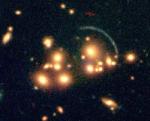 Ring Around the Cluster
4.01.1999
It is difficult to hide a galaxy behind a cluster of galaxies. The closer cluster's gravity will act like a huge lens, pulling images of the distant galaxy around the sides and greatly distorting them. This is just the case observed in the above recently released image from the VLT.
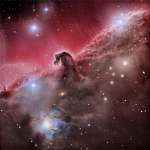 The Magnificent Horsehead Nebula
13.05.2010
Sculpted by stellar winds and radiation, a magnificent interstellar dust cloud by chance has assumed this recognizable shape. Fittingly named the Horsehead Nebula, it is some 1,500 light-years distant, embedded in the vast Orion cloud complex.
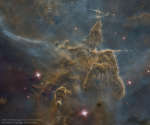 Mystic Mountain Dust Pillars
15.04.2015
It's stars versus dust in the Carina Nebula and the stars are winning. More precisely, the energetic light and winds from massive newly formed stars are evaporating and dispersing the dusty stellar nurseries in which they formed.
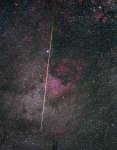 Lyrid Meteor Streak
23.04.2020
Earth's annual Lyrid Meteor Shower peaked before dawn yesterday, as our fair planet plowed through debris from the tail of long-period comet Thatcher. In crisp, clear and moonless predawn skies over Brown County...
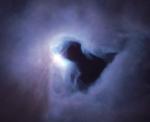 NGC 1999: Reflection Nebula In Orion
2.03.2000
A dusty bright nebula contrasts dramatically with a dusty dark nebula in this Hubble Space Telescope image recorded shortly after December's orbital servicing mission. The nebula, cataloged as NGC 1999, is a reflection nebula, which shines by reflecting light from a nearby star.
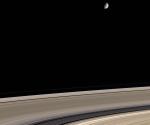 Saturn: Dirty Rings and a Clean Moon
6.06.2005
Eating surface ice from Enceladus might be healthier than eating ice from Saturn's rings -- it certainly appears cleaner. From their apparent densities and reflectance properties, both the rings of Saturn and its shiniest moon, Enceladus, are thought to be composed predominantly of water ice.
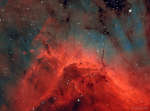 Pillars and Jets in the Pelican Nebula
3.03.2015
What dark structures arise from the Pelican Nebula? Visible as a bird-shaped nebula toward the constellation of a bird (Cygnus, the Swan), the Pelican Nebula is a place dotted with newly formed stars but fouled with dark dust.
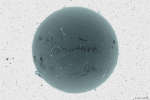 Black Sun and Inverted Starfield
19.02.2017
Does this strange dark ball look somehow familiar? If so, that might be because it is our Sun. In the featured image from 2012, a detailed solar view was captured originally in a very specific color of red light, then rendered in black and white, and then color inverted.
|
January February March April May June July August September |
|||||||||||||||||||||||||||||||||||||||||||||||||