
|
You entered: dark
 Solstice Illuminated: A Year of Sky
22.12.2019
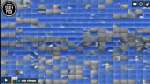
Can you find which day is the winter solstice? Each panel shows one day. With 360 movie panels, the sky over (almost) an entire year is shown in time lapse format as recorded by a video camera on the roof of the Exploratorium museum in San Francisco, California.
 Spot The Planet
10.12.1999
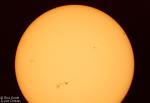
OK, it's a picture of the Sun (duh!), but can you spot the planet? Of course, most of the spots you've spotted are sunspots, as large or larger than planet Earth itself.
 Jupiter Abyss
10.06.2019
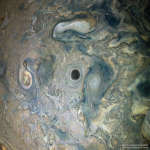
What's that black spot on Jupiter? No one is sure. During the latest pass of NASA's Juno around Jupiter, the robotic spacecraft imaged an usually dark cloud feature informally dubbed the Abyss. Surrounding cloud patterns show the Abyss to be at the center of a vortex.
 APOD: 2023 August 7 Б The Pelican Nebula in Gas, Dust, and Stars
7.08.2023
The Pelican Nebula is slowly being transformed. IC 5070 (the official designation) is divided from the larger North America Nebula by a molecular cloud filled with dark dust. The Pelican, however, receives much study because it is a particularly active mix of star formation and evolving gas clouds.
 The Milky Way Near the Northern Cross
15.05.1996
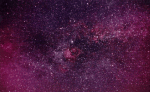
This beautiful image of the sky near the bright star Deneb (just above center) reveals the stars, nebulae, and dark clouds along the plane of our Milky Way Galaxy as seen from the northern hemisphere (near Columbia Missouri, USA). Just below Deneb lies the suggestively shaped North American emission nebula.
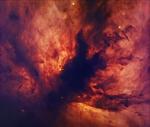 Flame Nebula Close Up
2.02.2007
Of course, the Flame Nebula is not on fire. Also known as NGC 2024, the nebula's suggestive reddish color is due to the glow of hydrogen atoms at the edge of the giant Orion molecular cloud complex some 1,500 light-years away.
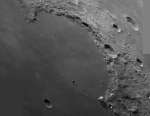 The Bay of Rainbows
8.02.2008
Dark, smooth regions that cover the Moon's familiar face are called by Latin names for oceans and seas. The naming convention is historical, though it may seem a little ironic to denizens...
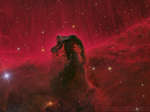 The Horsehead Nebula
17.12.2019
Sculpted by stellar winds and radiation, a magnificent interstellar dust cloud by chance has assumed this recognizable shape. Fittingly named the Horsehead Nebula, it is some 1,500 light-years distant, embedded in the vast Orion cloud complex.
 APOD: 2025 April 7 Б NGC 4414: A Flocculent Spiral Galaxy
7.04.2025
How much mass do flocculent spirals hide? The featured image of flocculent spiral galaxy NGC 4414 was taken with the Hubble Space Telescope to help answer this question. Flocculent spirals -- galaxies without well-defined spiral arms -- are a quite common form of galaxy, and NGC 4414 is one of the closest.
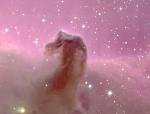 The Horsehead Nebula
16.12.2001
One of the most identifiable nebulae in the sky, the Horsehead Nebula in Orion, is part of a large, dark, molecular cloud. Also known as Barnard 33, the unusual shape was first discovered on a photographic plate in the late 1800s.
|
January February March April May June July August September |
|||||||||||||||||||||||||||||||||||||||||||||||||