
|
You entered: telescope
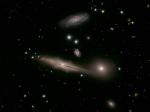 Galaxy Group HCG 87
31.07.2003
Posing for this cosmic family photo are the galaxies of HCG (Hickson Compact Group) 87, about four hundred million light-years distant toward the amphibious constellation Capricornus. The large edge-on spiral near picture center...
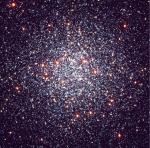 M55: Globular Star Cluster
18.09.2004
The fifty-fifth entry in Charles Messier's catalog, M55 is a large and lovely globular cluster of around 100,000 stars. Only 20,000 light-years away in the constellation Sagittarius, M55 appears to earth-bound observers to be nearly 2/3 the size of the full moon.
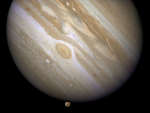 Jupiter Eclipsing Ganymede
6.01.2009
How hazy is Jupiter's upper atmosphere? To help find out, astronomers deployed the Hubble Space Telescope to watch Jupiter eclipse its moon Ganymede. Although Ganymede circles Jupiter once a week, it usually passes above or below the planet, so that a good eclipse occurs more rarely.
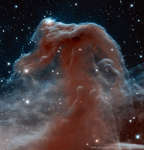 The Horsehead Nebula in Infrared from Hubble
8.06.2016
While drifting through the cosmos, a magnificent interstellar dust cloud became sculpted by stellar winds and radiation to assume a recognizable shape. Fittingly named the Horsehead Nebula, it is embedded in the vast and complex Orion Nebula (M42).
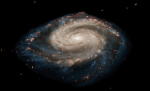 Virtual Flyby of the Whirlpool Galaxy
6.05.2019
What would it look like to fly over a spiral galaxy? To help visualize this, astronomers and animators at the Space Telescope Science Institute computed a virtual flyby of the Whirlpool Galaxy (M51) using data and images from the Hubble Space Telescope.
 Comet Leonard from Space
15.12.2021
What does Comet Leonard look like from space? Today's featured image from Origin.Space's Yangwang-1 space telescope shows not only the currently bright comet -- but several other space delights as well. Taken...
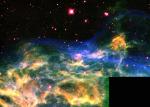 At the Edge of the Crescent Nebula
2.08.2000
The Crescent Nebula is a rapidly expanding shell of gas surrounding a dying star. In this recently released image by the Hubble Space Telescope, a bright dynamic part of the nebula three light-years across is shown in representative color.
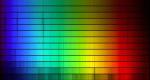 Stellar Spectral Types: OBAFGKM
30.05.2001
Astronomers divide stars into different spectral types. First started in the 1800s, the spectral type was originally meant to classify the strength of hydrogen absorption lines. A few types that best describe the temperature of the star remain in use today.
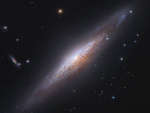 NGC 2683: Edge On Spiral Galaxy
5.02.2014
Does spiral galaxy NGC 2683 have a bar across its center? Being so nearly like our own barred Milky Way Galaxy, one might guess it has. Being so nearly edge-on, however, it is hard to tell.
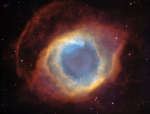 The Helix Nebula from Blanco and Hubble
12.10.2014
How did a star create the Helix nebula? The shapes of planetary nebula like the Helix are important because they likely hold clues to how stars like the Sun end their lives. Observations...
|
January February March April May June July August September October |
|||||||||||||||||||||||||||||||||||||||||||||||||