
|
You entered: telescope
 APOD: 2023 August 14 Б The Ring Nebula from Webb
14.08.2023
The Ring Nebula (M57), is more complicated than it appears through a small telescope. The easily visible central ring is about one light-year across, but this remarkable exposure by the James Webb Space Telescope explores this popular nebula with a deep exposure in infrared light.
 MWC 922: The Red Square Nebula
23.03.2011
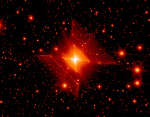
What could cause a nebula to appear square? No one is quite sure. The hot star system known as MWC 922, however, appears to be embedded in a nebula with just such a shape. The above image combines infrared exposures from the Hale Telescope on Mt.
 2MASS J17554042 6551277
19.03.2022
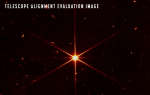
2MASS J17554042+6551277 doesn't exactly roll off the tongue but that's the name, a coordinate-based catalog designation, of the star centered in this sharp field of view. Fans of the distant universe should get used to its spiky appearance though.
 APOD: 2025 May 26 Б Spiral Galaxy NGC 2566 from Webb
26.05.2025
WhatБs happening in the center of spiral galaxy NGC 2566? First, the eight rays that appear to be coming out of the center in the featured infrared image are not real Б they are diffraction spikes caused by the mechanical structure of the Webb space telescope itself.
 A High Energy Fleet
25.02.1996
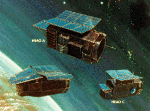
Looking like a fleet of futuristic starcruisers poised over planet Earth, NASA's highly successful series of High Energy Astrophysical Observatory (HEAO) spacecraft appear above in a vintage illustration. Labeled A, B, and C in this conceptual picture, the spacebased telescopes were known as HEAO-1, HEAO-2, and HEAO-3 respectively.
 The Supergalactic Wind from Starburst Galaxy M82
1.06.2004
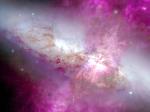
Star formation occurs at a faster pace in M82 -- a galaxy with about ten times the rate of massive star birth (and death) compared to our Milky Way. Winds from massive stars and blasts from supernova explosions have created a billowing cloud of expanding gas from this remarkable starburst galaxy.
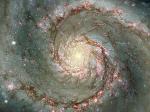 M51: The Whirlpool Galaxy in Dust and Stars
5.09.2004
The Whirlpool Galaxy is a classic spiral galaxy. At only 30 million light years distant and fully 60 thousand light years across, M51, also known as NGC 5194, is one of the brightest and most picturesque galaxies on the sky.
 Unexpected Impact on Jupiter
8.09.2009
Two months ago, something unexpected hit Jupiter. First discovered by an amateur astronomer Anthony Wesley on 2009 July 19, the impact was quickly confirmed and even imaged by the Hubble Space Telescope the very next day.
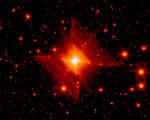 MWC 922: The Red Square Nebula
16.12.2012
What could cause a nebula to appear square? No one is quite sure. The hot star system known as MWC 922, however, appears to be embedded in a nebula with just such a shape. The above image combines infrared exposures from the Hale Telescope on Mt.
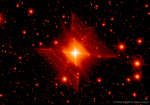 MWC 922: The Red Square Nebula
31.01.2016
What could cause a nebula to appear square? No one is quite sure. The hot star system known as MWC 922, however, appears to be embedded in a nebula with just such a shape. The featured image combines infrared exposures from the Hale Telescope on Mt.
|
January February March April May June July August September October |
|||||||||||||||||||||||||||||||||||||||||||||||||