
|
You entered: telescope
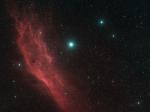 NGC 1499: The California Nebula
24.09.2006
What's California doing in space? Drifting through the Orion Arm of the spiral Milky Way Galaxy, this cosmic cloud by chance echoes the outline of California on the west coast of the United States.
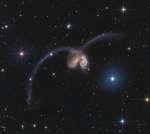 Exploring the Antennae
27.04.2017
Some 60 million light-years away in the southerly constellation Corvus, two large galaxies are colliding. Stars in the two galaxies, cataloged as NGC 4038 and NGC 4039, very rarely collide in the course of the ponderous cataclysm that lasts for hundreds of millions of years.
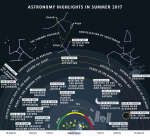 Highlights of the Summer Sky
4.06.2017
What's up in the sky this summer? The featured graphic gives a few highlights for Earth's northern hemisphere. Viewed as a clock face centered at the bottom, early summer sky events fan out toward the left, while late summer events are projected toward the right.
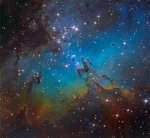 M16 Close Up
8.09.2021
A star cluster around 2 million years young surrounded by natal clouds of dust and glowing gas, M16 is also known as The Eagle Nebula. This beautifully detailed image of the region adopts the colorful Hubble palette and includes cosmic sculptures made famous in Hubble Space Telescope close-ups of the starforming complex.
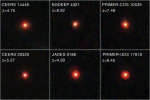 APOD: 2025 December 24 Б Mystery: Little Red Dots in the Early Universe
23.12.2025
What are these little red dots (LRDs)? Nobody knows. Discovered only last year, hundreds of LRDs have now been found by the James Webb Space Telescope in the early universe. Although extremely faint, LRDs are now frequently identified in deep observations made for other purposes.
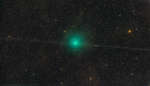 APOD: 2026 July 17 Б The Dust Trail of Comet Tempel 2
16.07.2026
Comet 10P/Tempel 2 orbits the Sun once every 5.4 years. Currently visible in binoculars or small telescopes toward the constellation Capricornus, the periodic comet is captured in this sharp telescopic image from July 11 sporting a bright nuclear region and pretty greenish coma.
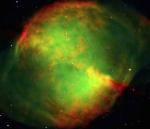 M27: Not A Comet
24.04.2004
While searching the skies above 18th century France for comets, astronomer Charles Messier diligently recorded this object as number 27 on his list of things which are definitely not comets. So what is it?
 An Inner Neptune for 55 Cancri
1.09.2004
Is our Solar System unique? The discovery of a Neptune-mass planet in an sub-Mercury orbit around nearby Sun-like star 55 Cancri, announced yesterday along with the discovery of other similar systems, gives a new indication that planetary systems as complex as our own Solar System likely exist elsewhere.
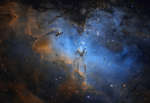 M16 and the Eagle Nebula
14.10.2015
A star cluster around 2 million years young surrounded by natal clouds of dust and glowing gas, M16 is also known as The Eagle Nebula. This beautifully detailed image of the region includes cosmic sculptures made famous in Hubble Space Telescope close-ups of the starforming complex.
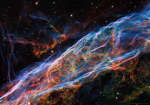 Veil Nebula: Wisps of an Exploded Star
4.04.2021
Wisps like this are all that remain visible of a Milky Way star. About 7,000 years ago that star exploded in a supernova leaving the Veil Nebula. At the time, the expanding cloud was likely as bright as a crescent Moon, remaining visible for weeks to people living at the dawn of recorded history.
|
January February March April May June July August September October |
|||||||||||||||||||||||||||||||||||||||||||||||||