
|
You entered: telescope
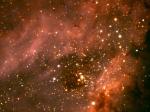 Composing the Omega Nebula
10.12.2000
The Omega Nebula is a massive, complex cloud of dust and gas from which new stars are continually forming. The similarity to the Greek letter capital Omega gives the molecular cloud its popular name, but the nebula is also known as the Swan Nebula, the Horseshoe Nebula, and M17.
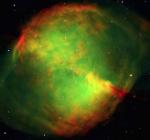 M27: Not A Comet
1.03.2002
While searching the skies above 18th century France for comets, astronomer Charles Messier diligently recorded this object as number 27 on his list of things which are definitely not comets. So what is it?
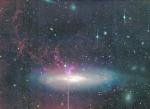 Galaxy NGC 4388 Expels Huge Gas Cloud
3.06.2002
Why are huge clouds of gas billowing from spiral galaxy NGC 4388? The extent of the gas clouds, over 100,000 light-years, was unexpected before the Subaru Telescope took the above image. NGC 4388 has a bright energetic nucleus and so is classified as an active galaxy.
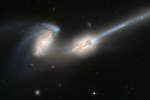 NGC 4676: When Mice Collide
23.02.2008
These two mighty galaxies are pulling each other apart. Known as " The Mice" because they have such long tails, each spiral galaxy has likely already passed through the other. They will probably collide again and again until they coalesce.
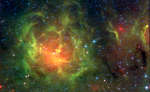 Spitzer s Trifid
12.02.2020
The Trifid Nebula, also known as Messier 20, is easy to find with a small telescope. About 30 light-years across and 5,500 light-years distant it's a popular stop for cosmic tourists in the nebula rich constellation Sagittarius.
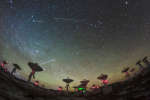 Quadrantids of the North
7.01.2022
Named for a forgotten constellation, the Quadrantid Meteor Shower puts on an annual show for planet Earth's northern hemisphere skygazers. The shower's radiant on the sky lies within the old, astronomically obsolete constellation Quadrans Muralis.
 APOD: 2025 November 2 Б A Horseshoe Einstein Ring from Hubble
1.11.2025
What's large and blue and can wrap itself around an entire galaxy? A gravitational lens mirage. Pictured here, the gravity of a massive elliptical galaxy (luminous red galaxy: LRG) has gravitationally distorted the light from a much more distant blue galaxy.
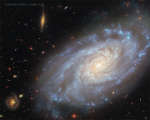 APOD: 2025 November 5 Б Spiral Galaxy NGC 3370 from Hubble
4.11.2025
Is this what our own Milky Way Galaxy looks like from far away? Similar in size and grand design to our home Galaxy (although without the central bar), spiral galaxy NGC 3370 lies about 100 million light-years away toward the constellation of the Lion (Leo).
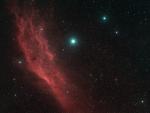 NGC 1499: California Nebula
9.03.2005
Drifting through the Orion Arm of the spiral Milky Way Galaxy, this cosmic cloud by chance echoes the outline of California on the west coast of the United States. Our own Sun also lies within the Milky Way's Orion Arm, only about 1,500 light-years from the California Nebula.
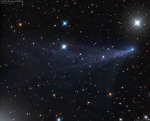 Blue Comet PanSTARRS
11.01.2018
Discovered with the PanSTARRS telescope on September 7, 2016, this Comet PanSTARRS, C/2016 R2, is presently about 24 light minutes (3 AU) from the Sun, sweeping through planet Earth's skies across the background of stars in the constellation Taurus.
|
January February March April May June July August September October |
|||||||||||||||||||||||||||||||||||||||||||||||||