
|
You entered: NASA
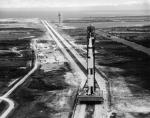 Moon Rocket
20.07.1999
On July 20, 1969, only four days after leaving planet Earth 250,000 miles behind them, Apollo 11 astronauts landed on the moon - the first humans to reach another celestial body. But the Saturn...
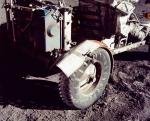 Lunar Dust and Duct Tape
10.11.2001
Why is the Moon dusty? On Earth, rocks are weathered by wind and water, creating soil and sand. On the Moon, the long history of micrometeorite bombardment has blasted away at the rocky surface creating a layer of powdery lunar soil or regolith. This lunar regolith could be a scientific and industrial bonanza.
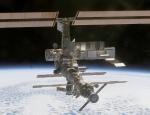 The International Space Station Expands Again
3.11.2002
The developing International Space Station (ISS) has changed its appearance yet again. Last month the Space Shuttle Atlantis visited the ISS and installed the third of eleven pieces that will compose the Integrated Truss Structure. The new S-1 Truss is visible on the right, below the extended solar panels across the top.
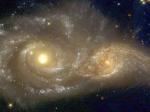 Spiral Galaxies in Collision
21.11.2004
Billions of years from now, only one of these two galaxies will remain. Until then, spiral galaxies NGC 2207 and IC 2163 will slowly pull each other apart, creating tides of matter, sheets of shocked gas, lanes of dark dust, bursts of star formation, and streams of cast-away stars.
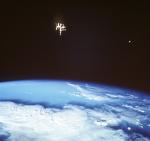 The Moons of Earth
30.04.2005
While orbiting the planet during their June 1998 mission, the crew of the Space Shuttle Discovery photographed this view of two moons of Earth. Thick storm clouds are visible in the lovely blue planet...
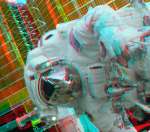 Take My Hand
18.09.2009
Get out your red/blue glasses and check out this close-up of spacesuited NASA astronaut John Olivas outside the International Space Station. Carefully constructed from two photographs (ISS020-E-038481, ISS02-0E-038482) taken during space shuttle orbiter Discovery...
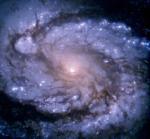 M100: A Grand Design
3.02.2001
Majestic on a truly cosmic scale, M100 is appropriately known as a Grand Design spiral galaxy. A large galaxy of over 100 billion or so stars with well defined spiral arms, it is similar to our own Milky Way.
 Methane Earth
12.02.2002
Can you help in reducing this blanket of methane gas that is warming up our Earth? Recent evidence holds that methane (CH4) is second only to carbon dioxide (CO2) in creating a warming greenhouse effect but is easier to control.
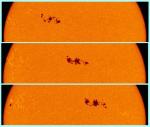 Sunspot Region 30
18.07.2002
The solar active region designated number 0030 is now appearing on the visible hemisphere of the closest star. Dwarfed by the Sun's disk, the group of sunspots which make up region 30 actually cover an enormous area -- nearly 10 times the size of Earth.
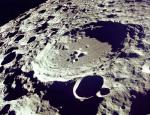 Lunar Farside from Apollo 11
12.03.2003
The far side of the Moon is rough and filled with craters. By comparison, the near side of the Moon, the side we always see, is relatively smooth. Since the Moon is rotation locked to always point the same side toward Earth, humanity has only glimpsed the lunar farside recently -- last century.
|
January February March April May June July August September October |
|||||||||||||||||||||||||||||||||||||||||||||||||