
|
You entered: NASA
 APOD: 2026 February 15 Б To Fly Free in Space
15.02.2026
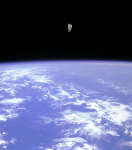
What would it be like to fly free in space? About 100 meters from the cargo bay of a space shuttle, Bruce McCandless II was living the dream -- floating farther out than anyone had ever been before. Guided by a Manned Maneuvering Unit (MMU), astronaut McCandless, pictured, was floating free in space.
 Apollo 12: Self-Portrait
4.11.2000
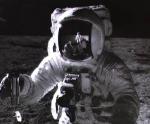
Is it art? In November of 1969, Apollo 12 astronaut-photographer Charles "Pete" Conrad recorded this masterpiece while documenting colleague Alan Bean's lunar soil collection activities on the Oceanus Procellarum. The image is dramatic and stark. Bean is faceless.
 Ultraviolet Earth from the Moon
1.07.2000
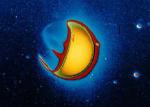
Here's a switch: the above picture is of the Earth taken from a lunar observatory! This false color picture shows how the Earth glows in ultraviolet (UV) light. UV light is so blue humans can't see it.
 Sagittarius Star Cloud
20.05.2001
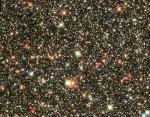
Stars come in all different colors. The color of a star indicates its surface temperature, an important property used to assign each star a spectral type. Most stars in the above Sagittarius Star Cloud are orange or red and relatively faint, as our Sun would appear.
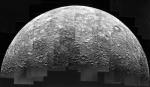 Mercury: A Cratered Inferno
19.08.2001
Mercury's surface looks similar to our Moon's. Each is heavily cratered and made of rock. Mercury's diameter is about 4800 km, while the Moon's is slightly less at about 3500 km (compared with about 12,700 km for the Earth). But Mercury is unique in many ways.
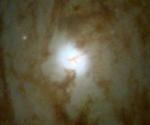 M51: The Center Of The Whirlpool
27.05.2000
In the center of M51, a spiral galaxy 23 million light-years away, astronomers have identified a dense region of young stars. Viewed face-on in the constellation Canes Venatici, the swirling arcs of this galaxy's spiral arms have inspired its popular name, The Whirlpool Galaxy.
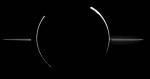 Jupiters Rings Revealed
16.06.2002
Why does Jupiter have rings? Jupiter's rings were discovered in 1979 by the passing Voyager 1 spacecraft, but their origin was a mystery. Data from the Galileo spacecraft currently orbiting Jupiter later confirmed that these rings were created by meteoroid impacts on small nearby moons.
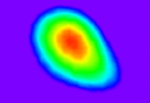 Painting with Solar Neutrons
25.10.1995
Solar flares are propelled high above the Sun's surface by powerful, twisted magnetic fields. The flares spew high energy atomic and subatomic particles into space. During an intense solar flare on June 15, 1991, a spray of solar neutrons was detected by the COMPTEL instrument onboard NASA's Compton Gamma Ray Observatory.
 N159 and the Papillon Nebula
21.12.2003
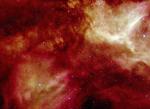
In a search for massive stars, the Hubble Space Telescope has peered into yet another spectacular region of star formation. This nebula, known as N159, spans over 150 light-years and is located in the neighboring Large Magellanic Cloud galaxy, about 170,000 light years distant.
 Infrared Trifid
13.01.2005
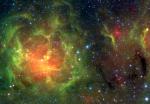
The Trifid Nebula, aka M20, is easy to find with a small telescope, a well known stop in the nebula rich constellation Sagittarius. But where visible light pictures show the nebula divided into three parts by dark, obscuring dust lanes, this penetrating infrared image reveals filaments of luminous gas and newborn stars.
|
January February March April May June July August September October |
|||||||||||||||||||||||||||||||||||||||||||||||||