
|
You entered: NASA
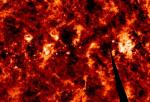 The Frothy Milky Way
24.04.1997
Astronomers have recently discovered that looking at dust along the plane of our Milky Way Galaxy is a bit like looking into a frothy glass of beer. The dust between stars in our galaxy...
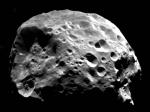 Phoebe: Comet Moon of Saturn
30.06.2004
Was Saturn's moon Phoebe once a comet? Images from the robotic Cassini spacecraft taken two weeks ago when entering the neighborhood of Saturn indicate that Phoebe may have originated in the outer Solar System.
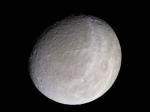 Saturns Moon Rhea from Cassini
14.02.2005
Each moon of Saturn seems to come with its own mystery. Rhea, Saturn's second largest moon behind Titan, shows unusual wisps, visible above as light colored streaks. Higher resolution images of the wisps show them to be made of long braided fractures.
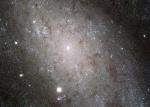 The Stars of NGC 300
20.08.2005
Like grains of sand on a cosmic beach, individual stars of large spiral galaxy NGC 300 are resolved in this sharp image from the Hubble Space Telescope's Advanced Camera for Surveys (ACS). The inner region of the galaxy is pictured, spanning about 7,500 light-years.
 Rocket Engine Fireplace
6.12.2024
You might not think a close up view of rocket engines producing 8.8 million pounds of thrust would be relaxing, but here it can be. In fact, you can get a warm and cozy feeling just spending a few moments watching NASA's holiday rocket engine fireplace.
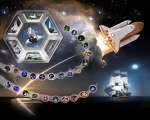 Space Shuttle Tribute Poster: Endeavour
7.09.2010
They are some of the most complex machines ever built. From a standing start they can launch a school- bus sized object up so high and moving so fast that it won't fall back down.
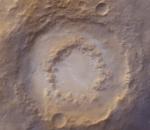 A Frosty Crater On Mars
30.11.2000
In the martian southern hemisphere, autumn has arrived. As on planet Earth, the cooler temperatures bring a seasonal frost to the landscape. Of course on Mars, the surface temperatures can be really cool, reaching below minus 100 degrees C.
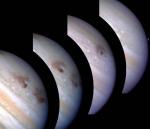 Jupiter Swallows Comet Shoemaker Levy 9
4.11.2000
What happens when a comet encounters a planet? If the planet has a rocky surface, a huge impact feature will form. A giant planet like Jupiter, however, is mostly gas. When Comet Shoemaker-Levy 9 struck Jupiter in 1994, each piece was swallowed into the vast Jovian atmosphere.
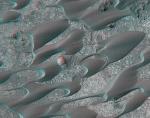 Mars: 3 D Dunes
15.08.2001
Get out your red/blue glasses and treat yourself to this dramatic 3-D view of sand dunes on Mars! The field of undulating dunes is found in Nili Patera, a volcanic depression in central Syrtis Major, the most prominent dark feature on the Red Planet.
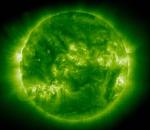 The Iron Sun
29.09.2001
The ultraviolet light emitted by eleven times ionized iron at temperatures over 2 million degrees Farenheit was used to record the above picture of the Sun on September 22, the date of the autumnal equinox.
|
January February March April May June July August September October |
|||||||||||||||||||||||||||||||||||||||||||||||||