
|
You entered: NASA
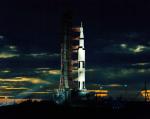 The Last Moon Shot
10.12.2005
In 1865 Jules Verne predicted the invention of a space capsule that could carry people. His science fiction story "From the Earth to the Moon" outlined his vision of a cannon in Florida so powerful that it could shoot a Projectile-Vehicle carrying three adventurers to the Moon.
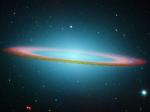 The Sombrero Galaxy in Infrared
21.01.2007
This floating ring is the size of a galaxy. In fact, it is part of the photogenic Sombrero Galaxy, one of the largest galaxies in the nearby Virgo Cluster of Galaxies. The dark band of dust that obscures the mid-section of the Sombrero Galaxy in optical light actually glows brightly in infrared light.
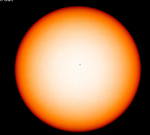 Mercury Crosses a Quiet Sun
2.12.2019
What's that black dot crossing the Sun? The planet Mercury. Mercury usually passes over or under the Sun, as seen from Earth, but last month the Solar System's innermost planet appeared to go just about straight across the middle.
 Odysseus on the Moon
2.03.2024
Methalox rocket engine firing, Odysseus' landing legs absorb first contact with the lunar surface in this wide-angle snapshot from a camera on board the robotic Intuitive Machines Nova-C moon lander. Following the landing on February 22, broken landing legs, visible in the image, ultimately left the lander at rest but tilted.
 APOD: 2025 May 4 Б Spin up of a Supermassive Black Hole
4.05.2025
How fast can a black hole spin? If any object made of regular matter spins too fast -- it breaks apart. But a black hole might not be able to break apart -- and its maximum spin rate is really unknown.
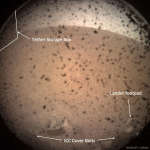 InSights First Image from Mars
27.11.2018
Welcome to Mars, NASA Insight. Yesterday NASA's robotic spacecraft InSight made a dramatic landing on Mars after a six-month trek across the inner Solar System. Needing to brake from...
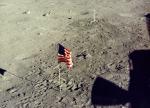 Footprints on Another World
20.07.2002
On July 20th, 1969, humans first set foot on the Moon. Taken from a window of their Apollo 11 lunar module, the Eagle, this picture shows the footprints in the powdery lunar soil made by astronauts Neil Armstrong and Buzz Aldrin.
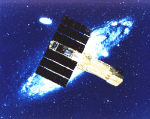 ASCA X-Ray Observatory
20.02.1996
Today marks the third anniversary of the launch of the Advanced Satellite for Cosmology and Astrophysics (ASCA; renamed from Astro D when launched). ASCA, seen here superposed on galaxy M31, is a Japanese satellite for which NASA has provided some scientific equipment. ASCA carries four large-area X-ray telescopes.
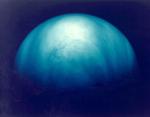 Venus: Just Passing By
29.09.2002
Venus, the second closest planet to the Sun, is a popular way-point for spacecraft headed for the gas giant planets in the outer reaches of the solar system. Why visit Venus first? Using...
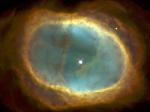 NGC 3132: The Eight Burst Nebula
13.09.2003
It's the dim star, not the bright one, near the center of NGC 3132 that created this odd but beautiful planetary nebula. Nicknamed the Eight-Burst Nebula and the Southern Ring Nebula, the glowing gas originated in the outer layers of a star like our Sun.
|
January February March April May June July August September October |
|||||||||||||||||||||||||||||||||||||||||||||||||