
|
You entered: NASA
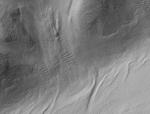 Young Martian Terrain
1.08.2001
What caused the pits, ridges, and gullies on otherwise smooth Martian terrain? One hypothesis is water. The lack of craters at this mid-latitude location indicates that the terrain is quite young by geological standards, perhaps only 100,000 years old.
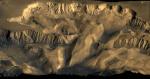 Candor and Ophir Chasmata
18.02.2003
First imaged by the Mariner 9 spacecraft, Valles Marineris, the grand canyon of Mars, is a system of enormous depressions called chasmata that stretch some 4,000 kilometers along the Martian equator. Looking north...
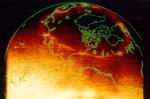 A Complete Aurora
2.04.1997
Aurora frequently make complete rings around a pole of the Earth. This particular "crown", visible in orange near the top of this image, was taken by the orbiting Polar spacecraft about one year ago and released by NASA last month.
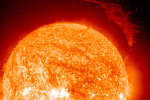 A Prominent Solar Prominence from SOHO
15.03.2009
What's happened to our Sun? It was sporting a spectacular -- but not very unusual -- solar prominence. A solar prominence is a cloud of solar gas held above the Sun's surface by the Sun's magnetic field.
 APOD: 2025 July 6 Б The Spiral North Pole of Mars
6.07.2025
Why is there a spiral around the North Pole of Mars? Each winter this pole develops a new outer layer about one meter thick composed of carbon dioxide frozen out of the thin Martian atmosphere. This fresh layer is deposited on a water-ice layer that exists year round.
 Webb and Hubble: IC 5332
26.02.2026
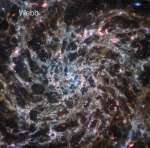
What does the universe look like through infrared goggles? Our eyes can only see visible light, but astronomers want to see more. TodayБs APOD shows spiral galaxy IC 5332 as seen by two NASA telescopes: Webb in mid-infrared and Hubble in ultraviolet and visible light.
 The Equal Night
23.09.2000
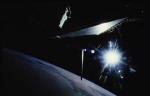
Yesterday the Sun crossed the celestial equator heading south, marking the Equinox -- the first day of Autumn in the northern hemisphere and Spring in the south. Equinox means equal night and with the Sun on the celestial equator, Earthlings will experience 12 hours of daylight and 12 hours of darkness.
 Shuttle Plume Shadow Points to Moon
19.02.2001
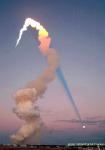
Why would the shadow of a space shuttle launch plume point toward the Moon? Two weeks ago during the launch of Atlantis, the Sun, Earth, Moon, and rocket were all properly aligned for this photogenic coincidence.
 Discovery Spring
20.03.2001
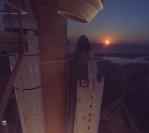
Welcome to the equinox! Moving northward in Earth's sky, today the Sun crosses the celestial equator at 13:31 Universal Time bringing Spring to the north and Fall to the south. The change...
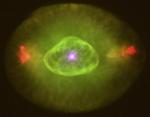 NGC 6826: The Blinking Eye
26.05.2001
The colorful planetary nebula phase of a sun-like star's life is brief. Almost in the "blink of an eye" - cosmically speaking - the star's outer layers are cast off, forming an expanding emission nebula. This nebula lasts perhaps 10 thousand years compared to a 10 billion year stellar life span.
|
January February March April May June July August September October |
|||||||||||||||||||||||||||||||||||||||||||||||||