
|
You entered: NASA
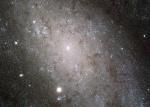 The Stars of NGC 300
16.04.2004
Like grains of sand on a cosmic beach, individual stars of large spiral galaxy NGC 300 are resolved in this sharp image from the Hubble Space Telescope's Advanced Camera for Surveys (ACS).
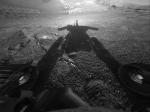 Shadow of a Martian Robot
3.08.2004
What if you saw your shadow on Mars and it wasn't human? Then you might be the Opportunity rover currently exploring Mars. Opportunity and sister robot Spirit have been probing the red planet since January, finding evidence of ancient water, and sending breathtaking images across the inner Solar System.
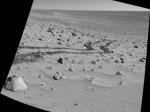 Looking Back Over Mars
15.12.2004
Pictured above, the path of the robot rover Spirit on Mars can be traced far into the distance. Spirit has now crossed kilometers of plains covered with rocks and sand, approached the lip of a crater 200-meters across, and climbed a series of hills.
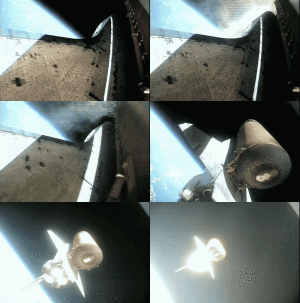 A Space Shuttle Climbs to Orbit
13.07.2006
You are going into space. New small cameras allow anyone with a web browser to virtually ride along with the space shuttle, at times from numerous angles, as it launches into Earth orbit. Small...
 The Frothy Milky Way
9.10.1999
Astronomers have discovered that looking at dust along the plane of our Milky Way Galaxy is a bit like looking into a frothy glass of beer. The dust between stars in our galaxy appears...
 APOD: 2026 February 22 Б Shadow of a Martian Robot
22.02.2026
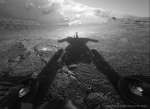
What if you saw your shadow on Mars and it wasn't human? Then you might be the Opportunity rover exploring Mars. Opportunity explored the Red Planet from 2004 to 2018, finding evidence of ancient water, and sending breathtaking images across the inner Solar System.
 A Solar Eclipse from the Moon
7.04.2014
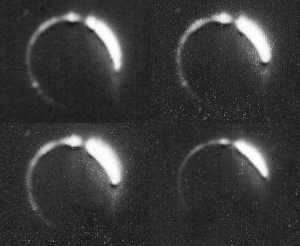
Has a solar eclipse ever been seen from the Moon? Yes, first in 1967 -- but it may happen again next week. The robotic Surveyor 3 mission took thousands of wide angle television images of the Earth in 1967, a few of which captured the Earth moving in front of the Sun.
 The Seasons of Saturn
2.07.2001
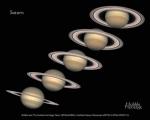
Soon it will be winter in Saturn's northern hemisphere. Since Saturn is tilted in its orbit around the Sun, it has seasons just like the Earth. When a hemisphere is tilted so that the Sun passes more directly overhead, summer occurs. Half an orbit later -- about 15 (Earth) years for Saturn -- winter occurs.
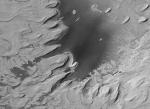 Ancient Layered Rocks on Mars
27.11.2001
Is this a picture of Mars or Earth? Oddly enough, it is a picture of Mars. What may appear to some as a terrestrial coastline is in fact a formation of ancient layered rocks and wind-blown sand on Mars. The above-pictured region spans about three kilometers in Schiaparelli Crater.
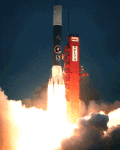 A Delta Rocket Launches
13.12.1995
A Delta rocket is seen being launched in 1988. In use since 1960, Delta rockets have been launched successfully over 200 times. Scientific satellites placed into orbit by a Delta rocket include IUE, COBE, LAGEOS-I, ROSAT, EUVE, GEOTAIL, and WIND.
|
January February March April May June July August September October |
|||||||||||||||||||||||||||||||||||||||||||||||||