
|
You entered: NASA
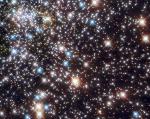 Oddities of Star Cluster NGC 6397
20.02.2002
One of these stars is blinking. This star, a member of globular cluster NGC 6397, is noteworthy not just because it blinks, but because it blinks so fast and because its companion star is so atypical.
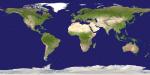 Earth in True Color
5.03.2002
Here are the true colors of planet Earth. Blue oceans dominate our world, while areas of green forest, brown mountains, tan desert, and white ice are also prominent. Oceans appear blue not only because water itself is blue but also because seawater frequently scatters light from a blue sky.
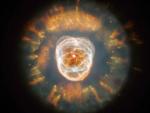 The Eskimo Nebula from Hubble
7.04.2002
In 1787, astronomer William Herschel discovered the Eskimo Nebula. From the ground, NGC 2392 resembles a person's head surrounded by a parka hood. In 2000, the Hubble Space Telescope imaged the Eskimo Nebula. From space, the nebula displays gas clouds so complex they are not fully understood.
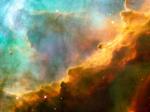 M17: A Hubble Close Up
25.04.2003
Sculpted by stellar winds and radiation, these fantastic, undulating shapes lie within the stellar nursery known as M17, the Omega Nebula, some 5,500 light-years away in the nebula-rich constellation Sagittarius. The lumpy features...
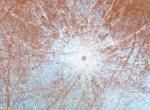 Pwyll: Icy Crater of Europa
17.04.1997
The impact crater Pwyll (a name from Celtic Mythology) is thought to represent one of the youngest features on the surface of Jupiter's moon Europa. A combination of color and high resolution black...
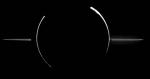 Jupiters Rings Revealed
9.01.2005
Why does Jupiter have rings? Jupiter's rings were discovered in 1979 by the passing Voyager 1 spacecraft, but their origin was a mystery. Data from the Galileo spacecraft that orbited Jupiter from 1995 to 2003 later confirmed that these rings were created by meteoroid impacts on small nearby moons.
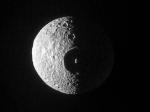 Crater on Mimas
8.03.2005
Whatever hit Mimas nearly destroyed it. What remains is one of the largest impact craters on one of Saturn's smallest moons. The crater, named Herschel after the 1789 discoverer of Mimas, Sir William Herschel, spans about 130 kilometers and is pictured above in the dramatic light of its terminator.
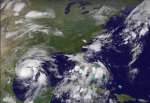 Hurricane Harvey Strengthens
26.08.2017
A large and dangerous hurricane has developed in the Gulf of Mexico. The featured time-lapse video shows Hurricane Harvey growing to Category 4 strength over the past few days, as captured by NASA and NOAA's GOES-East satellite.
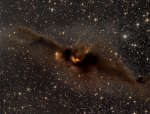 LDN 43: The Cosmic Bat Nebula
31.10.2022
What is the most spook-tacular nebula in the galaxy? One contender is LDN 43, which bears an astonishing resemblance to a vast cosmic bat flying amongst the stars on a dark Halloween night. Located...
 APOD: 2023 May 14 Б To Fly Free in Space
14.05.2023
What would it be like to fly free in space? At about 100 meters from the cargo bay of the space shuttle Challenger, Bruce McCandless II was living the dream -- floating farther out than anyone had ever been before. Guided by a Manned Maneuvering Unit (MMU), astronaut McCandless, pictured, was floating free in space.
|
January February March April May June July August September October |
|||||||||||||||||||||||||||||||||||||||||||||||||