
|
You entered: NASA
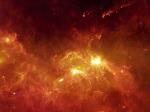 Orion in Infrared
19.04.2005
Do you recognize the constellation Orion? This striking but unfamiliar looking picture of the familiar Orion region of the sky was produced using survey data from the now-defunct InfraRed Astronomical Satellite (IRAS). The above image combines information recorded at three different invisible infrared wavelengths and covers about 30x24 degrees on the sky.
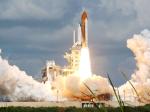 America Returns to Space Flight
27.07.2005
NASA's launch of the massive Space Shuttle Discovery yesterday brought a nation known for its tremendous space program back to human space flight. Shuttle flights had been suspended for over two years previously following the tragic loss of the Space Shuttle Columbia crew on 2003 February 1.
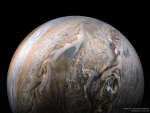 Tumultuous Clouds of Jupiter
6.01.2020
Some cloud patterns on Jupiter are quite complex. The featured tumultuous clouds were captured in May by NASA's robotic Juno spacecraft currently orbiting our Solar System's largest planet. The image was taken...
 A Quasar in the Gamma Ray Sky
17.11.1996
The bright object in the center of the false color image above is quasar 3C279 viewed in gamma-rays, photons with more than 40 million times the energy of visible light. Like all quasars, 3C279 is a nondescript, faint, starlike object in the visible sky.
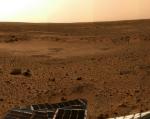 Sol 5 Postcard from Mars
9.01.2004
A martian Sol - the average martian solar day - is about 39 minutes longer than Earth's familiar 24 hour day. Operating on martian time, the Spirit rover recently sent back this color postcard image, recorded on Sol 5 of its stay on the martian surface.
 APOD: 2004 August 28- M17: A Hubble Close-Up
28.08.2004
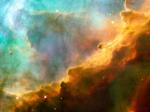
Sculpted by stellar winds and radiation, these fantastic, undulating shapes lie within the stellar nursery known as M17, the Omega Nebula, some 5,500 light-years away in the nebula-rich constellation Sagittarius. The lumpy features...
 Saturns Iapetus: Moon with a Strange Surface
1.02.2005
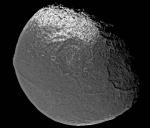
What has happened to Saturn's moon Iapetus? A strange ridge crosses the moon near the equator, visible near the bottom of the above image, making Iapetus appear similar to the pit of a peach. Half of Iapetus is so dark that it can nearly disappear when viewed from Earth.
 Inside Victoria Crater on Mars
17.09.2007
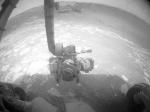
NASA's Opportunity rover is now inside Victoria Crater on Mars. Last week the robot rolled about 20 meters into the largest crater any Martian rover has yet encountered, the crater next to which Opportunity has been perched for months.
 Vanishing Act
21.06.2008
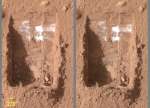
Compare these two close-up pictures taken on sol 20 (left) and sol 24 of a trench dug in the Martian surface by NASA's Phoenix Lander. Those sols of the Phoenix Mission (a sol is a Martian day), correspond to June 15 and 18 on planet Earth.
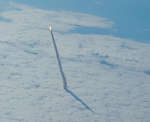 Space Shuttle Rising
24.05.2015
What's that rising from the clouds? The space shuttle. Sometimes, if you looked out the window of an airplane at just the right place and time, you could have seen something very unusual -- a space shuttle launching to orbit.
|
January February March April May June July August September October |
|||||||||||||||||||||||||||||||||||||||||||||||||