
|
You entered: NASA
 The Fairy of Eagle Nebula
25.04.2005
The dust sculptures of the Eagle Nebula are evaporating. As powerful starlight whittles away these cool cosmic mountains, the statuesque pillars that remain might be imagined as mythical beasts. Pictured above is one of several striking dust pillars of the Eagle Nebula that might be described as a gigantic alien fairy.
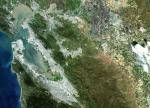 Landsat 7 Views Planet Earth
14.05.1999
Launched last month, NASA's Landsat 7 spacecraft now orbits planet Earth. Looking down from an altitude of 700 km, Landsat 7 can map the planet's surface in visible and infrared bands and resolve features 30 meters across or smaller.
 The Cosmic Infrared Background
5.02.2002
What cosmic wallpaper is on the sky? The answer depends on the type of light considered, and for some wavelengths, all the cluttering material in the foreground makes it still unknown. Recently, however...
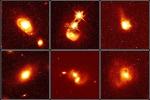 A Quasar Portrait Gallery
8.03.2002
Quasars (QUASi-stellAR objects) lie near the edge of the observable Universe. Discovered in 1963, astronomers were astounded that such objects could be visible across billions of light-years, as this implies they must emit prodigious amounts of energy. Where does the energy come from?
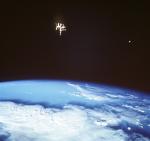 The Moons of Earth
4.05.2002
While orbiting the planet during their June 1998 mission, the crew of the Space Shuttle Discovery photographed this view of two moons of Earth. Thick storm clouds are visible in the lovely blue planet...
 Shuttle Engine Blast
31.12.1995
The Space Shuttle Discovery's orbital maneuvering system (OMS) engine firing produced this dramatic flare as it cruised "upside down" in low Earth orbit. Discovery was named for a ship commanded by Captain James Cook RN, the 18th Century English astronomer and navigator.
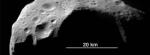 Asteroid 253 Mathilde's Large Craters
1.07.1997
You're zipping through the Solar System when you pass ... asteroid 253 Mathilde. This actually happened to NASA's NEAR spacecraft just last Friday. The above picture of the previously unresolved asteroid was released just yesterday.
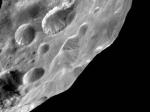 Unusual Layers on Saturns Moon Phoebe
14.06.2004
What caused the unusual light and dark layers on Saturn's moon Phoebe? The layers were discovered just Friday during the Cassini spacecraft flyby of the small moon. Such layering is particularly evident on the crater just above the image center, where alternating light and dark material makes this crater appear particularly structured.
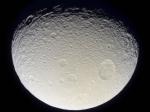 Saturns Moon Tethys from Cassini
28.11.2004
Tethys is one of the larger and closer moons of Saturn. The Cassini spacecraft now orbiting Saturn passed near the frozen moon at the end of October, capturing the most detailed images since the Voyager spacecrafts in the early 1980s.
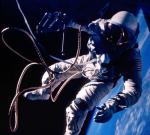 First US Spacewalk
4.06.2005
In 1965, forty years ago on June 3rd, astronaut Edward White made the first U.S. spacewalk. Tethered to his Gemini IV capsule, White is pictured above holding a compressed gas "zip gun" for maneuvers in his right hand.
|
January February March April May June July August September October |
|||||||||||||||||||||||||||||||||||||||||||||||||