
|
You entered: NASA
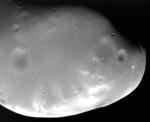 Deimos: A Small Martian Moon
2.09.2001
Mars has two tiny moons, Phobos and Deimos. Pictured above is Deimos, the smaller moon of Mars. In fact, Deimos is one of the smallest known moons in the Solar System measuring only nine miles across.
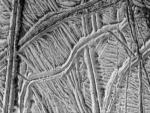 Cracks and Ridges on Europa
2.06.2002
Which way to the interstate? What appears to be a caricature of a complex highway system on Earth is actually a system of ridges and cracks on the icy surface of Jupiter's moon Europa. The distance between parallel ridges in the above photograph is typically about 1 kilometer.
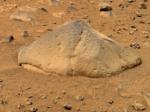 Adirondack Rock on Mars
20.01.2004
Is this a great pyramid on Mars? Actually, the pictured rock dubbed Adirondack has an irregular shape, is only about the size of a football, and has formed by natural processes. Still, its relatively large size and dust-free surface made it the first destination for the robotic Spirit rover currently roving Mars.
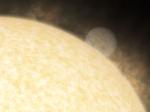 Light from a Extra Solar Planet
5.04.2005
Light emitted by a planet far beyond our Solar System has been identified for the first time. The planet, illustrated in the above drawing, had its light detected by comparing the brightness of only...
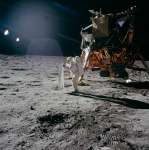 APOD: 2026 September 12 Б Apollo 11: Catching Some Sun
11.09.2026
Bright sunlight glints as long dark shadows mark this image of the surface of the Moon. It was taken on July 20, 1969, by Apollo 11 astronaut Neil Armstrong, the first to walk on the lunar surface. Pictured is the mission's lunar module, the Eagle, and spacesuited lunar module pilot Buzz Aldrin.
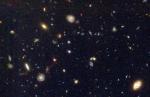 A Deep Field In The Southern Sky
29.06.2002
This deep view of the cosmos is the sequel to the 1995 hit Hubble Space Telescope Deep Field. Billed as the Hubble Deep Field South, it was produced by pointing the space telescope toward a patch of sky in the southern constellation Tucana.
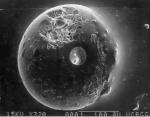 A Spherule from Outer Space
11.01.2003
When a meteorite strikes the Moon, the energy of the impact melts some of the splattering rock, a fraction of which might cool into tiny glass beads. Many of these glass beads were present in lunar soil samples returned to Earth by the Apollo missions.
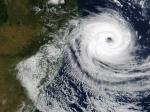 Unusually Strong Cyclone Off the Brazilian Coast
6.04.2004
How did this huge cyclone form? An unusually strong storm -- perhaps the strongest storm in the recorded history of the South Atlantic Ocean -- crossed the coast of Brazil last week. Cyclones this powerful, classified by some as the first ever Category 1 Hurricane, are very rare in the South Atlantic.
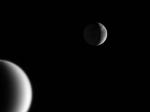 Crescents of Titan and Dione
29.03.2005
What would it be like to see a sky with many moons? Such is the sky above Saturn. When appearing close to each other, moons will show a similar phase. A view with...
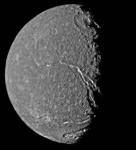 Titania's Trenches
30.09.2000
British astronomer Sir William Herschel discovered Titania and Oberon in January of 1787. He wasn't reading Shakespeare's A Midsummer Night's Dream though, he was making the first telescopic observations of moons of the planet Uranus (a planet which he himself discovered in 1781).
|
January February March April May June July August September October |
|||||||||||||||||||||||||||||||||||||||||||||||||