
|
You entered: NASA
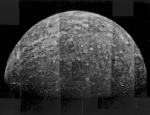 Mercury: Closest Planet to the Sun
14.08.1995
This picture was compiled from images taken by the NASA spacecraft Mariner 10 which flew by the planet three times in 1974. Mercury is the closest planet to the Sun, the second hottest planet (Venus gets hotter), and the second smallest planet (Pluto is smaller).
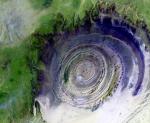 Earths Richat Structure
28.10.2002
What on Earth is that? The Richat Structure in the Sahara Desert of Mauritania is easily visible from space because it is nearly 50 kilometers across. Once thought to be an impact crater, the Richat Structure's flat middle and lack of shock-altered rock indicates otherwise.
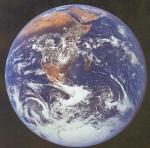 Welcome to Planet Earth
2.01.2005
Welcome to Planet Earth, the third planet from a star named the Sun. The Earth is shaped like a sphere and composed mostly of rock. Over 70 percent of the Earth's surface is water. The planet has a relatively thin atmosphere composed mostly of nitrogen and oxygen.
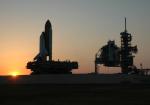 Discovery in Motion
8.07.2006
On July 4th, the space shuttle orbiter Discovery rocketed into space on mission STS-121. Now docked with the International Space Station, Discovery orbits planet Earth at about 27 thousand kilometers per hour.
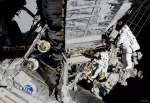 All Female Spacewalk Repairs Space Station
19.10.2019
The failed unit was beyond the reach of the robotic Canadarm2. Therefore, this repair of the International Space Station would require humans. The humans on duty were NASA's Jessica Meir and Christina Koch. This was the fourth spacewalk for Meir, the first for Koch, and the first all-female spacewalk in human history.
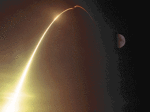 Destination: Moon
8.01.1998
Tuesday, January 6, at 9:28 p.m. EST, NASA's Lunar Prospector spacecraft climbed into the sky above Cape Canaveral Air Station riding an Athena II rocket. Representing NASA's first Moon mission since...
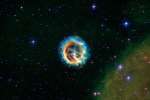 Supernova Remnant E0102 72
5.09.2009
The expanding debris cloud from the explosion of a massive star is captured in this multiwavelength composite, combining x-ray and optical images from the Chandra and Hubble telescopes. Identified as E0102-72, the supernova remnant lies about 190,000 light-years away in our neighboring galaxy, the Small Magellanic Cloud.
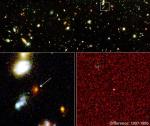 Distant Supernova Dark Energy
4.04.2001
Light from a star that exploded over 10 billion light-years away is revealed in the panel at the lower right, a cosmic snapshot of the most distant supernova. The ancient stellar detonation was detected...
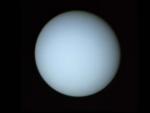 Uranus: The Tilted Planet
26.08.2001
Uranus is the third largest planet in our Solar System after Jupiter and Saturn. Uranus is composed mostly of rock and ices, but with a thick hydrogen and helium atmosphere. The blue hue of Uranus' atmosphere arises from the small amount of methane which preferentially absorbs red light.
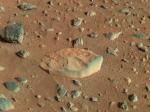 White Boat Rock on Mars
25.02.2004
What caused this rock to have an unusual shape? Earlier this month the robot Spirit rover on Mars stopped to examine a rock dubbed "white boat", named for its unusually light color and shape.
|
January February March April May June July August September October |
|||||||||||||||||||||||||||||||||||||||||||||||||