
|
You entered: NASA
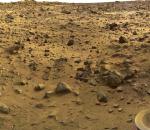 25 Years Ago: Vikings on Mars
21.07.2001
On July 20, 1976, NASA's Viking 1 lander become the first spacecraft to land on Mars, followed weeks later by its twin robot explorer, the Viking 2 lander. Operating on the Martian surface...
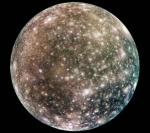 Callisto Full Face
20.01.2002
Callisto's surface shows its age. While probably formed at the same time as Io, the difference between the surfaces of these two moons of Jupiter could hardly be greater. Io's surface is young, shows practically no impact craters, and is continually being repaved by the lava exploding from its many large volcanoes
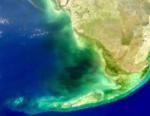 Mysterious Black Water in Florida Bay
2.04.2002
What is causing the water in Florida Bay to turn black? The mysterious black color could be seen as early as last December in images taken by the SeaWIFS instrument on board the Earth-orbiting SeaStar satellite.
 Crossing The Ring Plane
1.08.1995
"I do not know what to say in a case so surprising, so unlooked for and so novel." announced Galileo when Saturn's rings appeared to vanish in 1612. In fact, every 15 years Saturn's rings seem to almost disappear as viewed from the Earth.
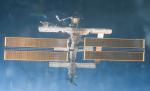 The International Space Station Expands Yet Again
8.12.2002
The developing International Space Station (ISS) has changed its appearance yet again. Earlier this month the Space Shuttle Endeavor visited the ISS and installed the fourth of eleven pieces that will compose the Integrated Truss Structure. The new P-1 Truss is visible on the left, below the extended solar panels.
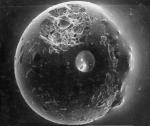 A Spherule from the Earths Moon
15.02.2004
How did this spherule come to be on the Moon? When a meteorite strikes the Moon, the energy of the impact melts some of the splattering rock, a fraction of which might cool into tiny glass beads. Many of these glass beads were present in lunar soil samples returned to Earth by the Apollo missions.
 Attacking Mars
19.07.2004
The Spirit rover attacked Mars again late last month. What might look, above, like a military attack, though, was once again just a scientific one - Spirit was instructed to closely inspect some interesting rocks near Columbia Hills.
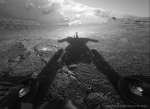 Shadow of a Martian Robot
17.02.2019
What if you saw your shadow on Mars and it wasn't human? Then you might be the Opportunity rover currently exploring Mars. Opportunity explored the red planet from 2004 to 2018, finding evidence of ancient water, and sending breathtaking images across the inner Solar System.
 Early Microscopic Life on Mars?
7.08.1996
Today a team of NASA and Stanford scientists announced the discovery of strong circumstantial evidence that microscopic life once existed on Mars. Dr. David McKay, Dr. Everett Gibson, and Kathie Thomas-Keprta of Lockheed-Martin, all from (NASA /JSC), and Dr.
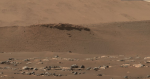 Perseverance 360: Unusual Rocks and the Search for Life on Mars
9.03.2021
Is that a fossil?б Looking through recent images of Mars taken by the new Perseverance rover may seem a bit like treasure hunting, with the possibility of fame coming to the first person...
|
January February March April May June July August September October |
|||||||||||||||||||||||||||||||||||||||||||||||||