
|
You entered: NASA
 A Great White Spot on Rhea
30.05.2005
Why caused this great white spot on the surface of Saturn's moon Rhea? The spot was first noticed last year by the robot Cassini spacecraft now orbiting Saturn. Cassini's flyby of Rhea in April imaged in the spot in great detail.
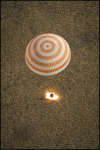 A Landing on Planet Earth
14.09.2013
With parachute deployed and retro-rockets blazing, this spacecraft landed on planet Earth on September 11 (UT) in a remote area near the town of Zhezkazgan, Kazakhstan. Seen in silhouette against the rockets' glare, the spacecraft is a Soyuz TMA-08M.
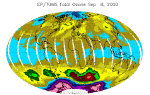 Antarctic Ozone Hole Widens
11.09.2000
It's back, and it's bigger than ever. The ozone hole that has been a cause of concern in recent years has again reformed over Earth's South Pole. The seasonal recurrence of the ozone hole was expected, although the size of the hole has never been so large this early in the season.
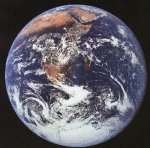 Welcome to Planet Earth
4.02.2001
Welcome to Planet Earth, the third planet from a star named the Sun. The Earth is shaped like a sphere and composed mostly of rock. Over 70 percent of the Earth's surface is water. The planet has a relatively thin atmosphere composed mostly of nitrogen and oxygen.
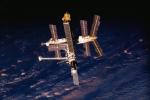 A Mirry Christmas
24.12.1996
Thinking about spending the Holiday Season in low Earth orbit? Astronaut John Blaha and his cosmonaut colleagues Valeri Korzun and Alexander Kaleri are doing just that onboard the Russian Mir spacestation. You can e-mail them Seasons Greetings.
 Astronaut at Work
30.05.2004
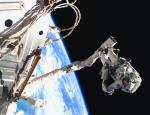
Did you ever have a day where everything got turned around and you just couldn't tell which way was up? Fortunately, this didn't happen to astronaut James S. Voss on 2000 May 21, who spent six hours preparing to fix and upgrade the International Space Station.
 Earth at Night
13.02.2022
This is what the Earth looks like at night. Can you find your favorite country or city? Surprisingly, city lights make this task quite possible. Human-made lights highlight particularly developed or populated areas of the Earth's surface, including the seaboards of Europe, the eastern United States, and Japan.
 North Pole Below
20.10.2000
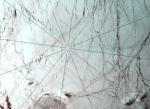
Orbiting over the north pole of planet Earth on May 5, the MODIS instrument on-board the Terra spacecraft, recorded this view of the ice cap 700 kilometers below. A radial grid centered on the pole is shown on top of the approximately true color image where each pixel covers about one square kilometer.
 A Continuous Eruption on Jupiters Moon Io
6.06.2000
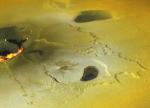
A volcano on Jupiter's moon Io has been photographed recently during an ongoing eruption. Hot glowing lava is visible on the left on this representative-color image. A glowing landscape of plateaus and valleys covered in sulfur and silicate rock surrounds the active volcano.
 A Russian Proton Rocket Launches Zvezda
18.07.2000
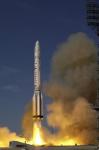
The Russian Proton rocket is the tallest rocket in routine use. First deployed in 1965, the rocket stands typically 40 meters tall, can carry unusually heavy payloads into space, and maintains a high record of reliability.
|
January February March April May June July August September October |
|||||||||||||||||||||||||||||||||||||||||||||||||