
|
You entered: NASA
 A High Energy Fleet
25.11.2000
Like a fleet of futuristic starcruisers, NASA's highly successful series of High Energy Astrophysical Observatory (HEAO) spacecraft appear poised over planet Earth. Labeled A, B, and C in this vintage illustration, the spacebased telescopes were known as HEAO-1, HEAO-2, and HEAO-3 respectively.
 Happy Birthday Jules Verne
17.02.2001
One hundred seventy-three years ago on February 8th, Jules Verne was born in Nantes, France. Inspired by a lifelong fascination with machines, Verne wrote visionary works about "Extraordinary Voyages" including such terrestrial travels as Around the World in 80 Days, Journey to the Centre of the Earth, and Twenty Thousand Leagues Under the Sea.
 Moonset, Planet Earth
28.10.2000
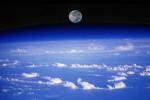
During the Astro-1 astronomy mission of December, 1990, Space Shuttle astronauts photographed this stunning view of the full moon rising above the Earth's limb. In the foreground, towering clouds of condensing water vapor mark the extent of the troposphere, the lowest layer of the planet's life-sustaining atmosphere.
 A Space Station Meets its Destiny
28.02.2001
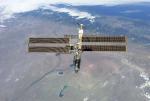
The International Space Station (ISS) had a date with Destiny earlier this month. More specifically, the crew of the Space Shuttle Atlantis installed the science laboratory named Destiny on the ISS. Destiny, pictured here, will also serve as a control center for the Earth orbiting space station.
 Working in Space
29.05.2001
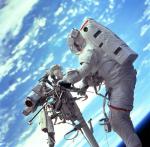
High above planet Earth, a human helps an ailing machine. The machine, in this potentially touching story, is the Hubble Space Telescope, which is not in the picture. The human is Astronaut Steven L.
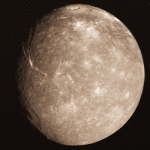 Uranus' Largest Moon: Titania
4.03.1996
Titania's tortured terrain is a mix of valleys and craters. NASA's interplanetary robot spacecraft Voyager 2 passed this moon of Uranus in 1986 and took the above photograph. The photograph was then transmitted back to earth by radio.
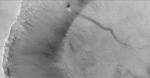 A Dust Devil on Mars
3.09.2002
Does the surface of Mars change? When inspecting yearly images of the Martian surface taken by the robot spacecraft Mars Global Surveyor currently orbiting Mars, sometimes new dark trails are visible. Although originally...
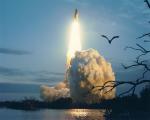 Columbia Launches
10.11.1996
Rocket engines blazing, the Space Shuttle Columbia arcs into Florida's morning sky after lifting off from pad 39-A at Kennedy Space Center. Seen here in January of 1996, this space shuttle has been...
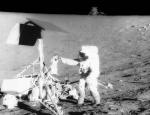 Apollo 12 Visits Surveyor 3
5.10.2003
Apollo 12 was the second mission to land humans on the Moon. The landing site was picked to be near the location of Surveyor 3, a robot spacecraft that had landed on the Moon three years earlier.
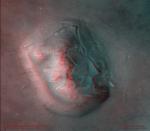 3D Face on Mars
21.04.2007
Get out your red/blue glasses and gaze down on this weathered mesa on Mars. Of course, described as a rock formation which resembles a human head in a 1976 NASA press release, this mesa is also famous as the Face on Mars.
|
January February March April May June July August September October |
|||||||||||||||||||||||||||||||||||||||||||||||||