
|
You entered: NASA
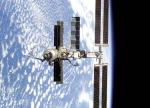 Space Station Shows Off New Robot Arm
9.05.2001
The International Space Station (ISS) continues to grow. Last month, the crew of the Space Shuttle Endeavor delivered new Logistics Modules and installed the new Canadarm2 on the growing outpost. The ISS -- complete with its new arm -- was photographed 400 kilometers above planet Earth by the Space Shuttle Endeavor crew soon after they undocked.
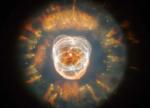 The Eskimo Nebula from Hubble
7.12.2003
In 1787, astronomer William Herschel discovered the Eskimo Nebula. From the ground, NGC 2392 resembles a person's head surrounded by a parka hood. In 2000, the Hubble Space Telescope imaged the Eskimo Nebula. From space, the nebula displays gas clouds so complex they are not fully understood.
 Heat Shield Impact Crater on Mars
9.02.2005
Broken metal and scorched Mars make the impact site of Opportunity's heat shield one of the more interesting sites inspected by the rolling robot. Visible on the image left is the conical outer hull of the shattered heat shield expelled by Opportunity as it plummeted toward Mars last year.
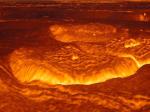 Venus Once Molten Surface
10.04.2005
If you could look at Venus with radar eyes - this is what you might see. This computer reconstruction of the surface of Venus was created from data from the Magellan spacecraft. Magellan orbited Venus and used radar to map our neighboring planet's surface between 1990 and 1994.
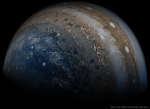 Beneath Jupiter
29.05.2017
Jupiter is stranger than we knew. NASA's Juno spacecraft has now completed its sixth swoop past Jupiter as it moves around its highly elliptical orbit. Pictured, Jupiter is seen from below where, surprisingly, the horizontal bands that cover most of the planet disappear into swirls and complex patterns.
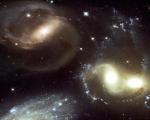 Disorder in Stephan's Quintet
13.11.2000
What are four closely grouped galaxies doing in this image? The grouping composes a majority of the large galaxies in Stephan's Quintet, with the fifth prominent galaxy located off the above image to the lower right.
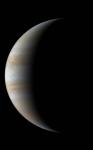 Farewell Jupiter
9.03.2003
Next stop: Saturn. The Cassini spacecraft, launched from Earth in 1997, has now swung past Jupiter and should arrive at Saturn in the year 2004. Pictured to the left is a parting shot from Cassini in January that would not have been possible from Earth: Jupiter showing a crescent phase.
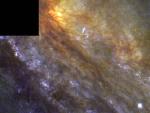 NGC 253: The Sculptor Galaxy
16.03.2003
NGC 253 is not only one of the brightest spiral galaxies visible, it is also one of the dustiest. Discovered in 1783 by Caroline Herschel in the constellation of Sculptor, NGC 253 lies only about ten million light-years distant.
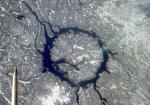 Manicouagan Impact Crater on Earth
13.12.2000
The Manicouagan Crater in northern Canada is one of the oldest impact craters known. Formed during a surely tremendous impact about 200 million years ago, the present day terrain supports a 70-kilometer diameter hydroelectric reservoir in the telltale form of an annular lake
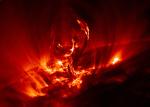 A Solar Filament Lifts Off
25.07.2004
Hot gas frequently erupts from the Sun. One such eruption produced the glowing filament pictured above, which was captured in 2000 July by the Earth-orbiting TRACE satellite. The filament, although small compared...
|
January February March April May June July August September October |
|||||||||||||||||||||||||||||||||||||||||||||||||