
|
You entered: NASA
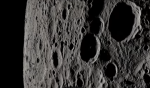 Apollo 13 Views of the Moon
3.03.2020
What if the only way to get back to Earth was to go around the far side of the Moon? Such was the dilemma of the Apollo 13 Crew in 1970 as they tried to return home in their unexpectedly damaged spacecraft.
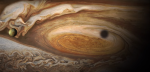 Juno Mission Trailer
28.06.2016
What will NASA's Juno spacecraft find when it reaches Jupiter next Monday? Very little, if Juno does not survive Jupiter Orbit Insertion, a complex series of operations in an unknown environment just above Jupiter's cloud tops.
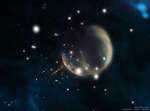 Supernova Cannon Expels Pulsar J0002
13.08.2019
What could shoot out a neutron star like a cannon ball? A supernova. About 10,000 years ago, the supernova that created the nebular remnant CTB 1 not only destroyed a massive star but blasted its newly formed neutron star core -- a pulsar -- out into the Milky Way Galaxy.
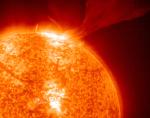 A Solar Prominence Erupts
24.09.2001
Our Sun is still very active. Last year, our Sun went though Solar Maximum, the time in its 11-year cycle where the most sunspots and explosive activities occur. Sunspots, the Solar Cycle, and solar prominences are all caused by the Sun's changing magnetic field.
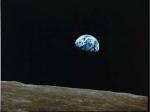 Earth Rise
27.01.2002
During 1968, the Apollo 8 crew flew from the Earth to the Moon and back. The crew, consisting of Frank Borman, James Lovell, and Willian Anders, were launched atop a Saturn V rocket on December 21, circled the Moon ten times in their command module, and landed back on Earth on December 27.
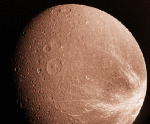 Saturn's Moon Dione
9.10.1995
Dione, one of Saturn's larger moons, is remarkable for its bright surface streaks. These streaks run across some of Dione's many craters, which indicate that the process which created the streaks occurred later than the process which created the craters.
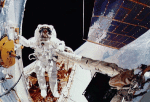 Repairing Hubble
16.11.1995
The first Hubble Space Telescope (HST) servicing mission, STS-61, was one of the most complicated shuttle missions ever planned. Launched on December 2, 1993 in the Space Shuttle Endeavor, the astronauts were required to make 5 space walks to repair the HST. Astronaut F.
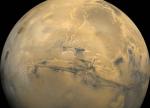 Valles Marineris: The Grand Canyon of Mars
27.08.2002
The largest canyon in the Solar System cuts a wide swath across the face of Mars. Named Valles Marineris, the grand valley extends over 3,000 kilometers long, spans as much as 600 kilometers across, and delves as much as 8 kilometers deep.
 Two Hours Before Neptune
22.09.2002
Two hours before closest approach to Neptune in 1989, the Voyager 2 robot spacecraft snapped this picture. Clearly visible for the first time were long light-colored cirrus-type clouds floating high in Neptune's atmosphere. Shadows of these clouds can even be seen on lower cloud decks.
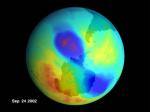 A Small Double Ozone Hole in 2002
22.10.2002
As expected, the ozone hole near Earth's South Pole is back again this year. This time, however, it's smaller than the past two years, and has an unusual double lobe structure. Ozone is important because it shields us from damaging ultraviolet sunlight.
|
January February March April May June July August September October |
|||||||||||||||||||||||||||||||||||||||||||||||||