
|
You entered: constellation
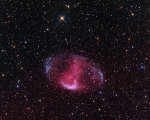 Methuselah Nebula MWP1
21.10.2010
The lovely, symmetric planetary nebula cataloged as MWP1 lies some 4,500 light-years away in the northern constellation Cygnus the Swan. One of the largest planetary nebulae known, it spans about 15 light-years. Based...
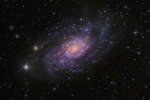 NGC 2403 in Camelopardalis
26.03.2015
Magnificent island universe NGC 2403 stands within the boundaries of the long-necked constellation Camelopardalis. Some 10 million light-years distant and about 50,000 light-years across, the spiral galaxy also seems to have more than its fair share of giant star forming HII regions, marked by the telltale reddish glow of atomic hydrogen gas.
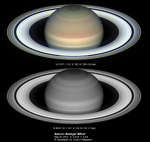 Saturn at Opposition
29.05.2015
Telescopic observers on Earth have been treated to spectacular views of Saturn lately as the ringed planet reached its 2015 opposition on May 23 at 0200 UT. Of course opposition means opposite the Sun in Earth's sky. So near opposition Saturn is up all night, at its closest and brightest for the year.
 Star Colors and Pinyon Pine
24.12.2015
Beautiful, luminous decorations on this pinyon pine tree are actually bright stars in the constellation Scorpius and the faint glow of the central Milky Way. Captured in June from the north...
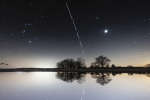 Reflecting the International Space Station
28.05.2020
Still bathed in sunlight, the International Space Station arced through the evening sky over lake Wulfsahl-Gusborn in northern Germany, just after sunset on March 25. The familiar constellation of Orion can be seen left of the trail of the orbital station's bright passage.
 The Fornax Cluster of Galaxies
29.01.2022
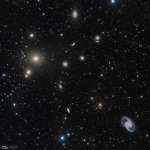
Named for the southern constellation toward which most of its galaxies can be found, the Fornax Cluster is one of the closest clusters of galaxies. About 62 million light-years away, it is almost...
 Meteors along the Milky Way
24.08.2023
Under dark and mostly moonless night skies, many denizens of planet Earth were able to watch this year's Perseid meteor shower. Seen from a grassy hillside from Shiraz, Iran these Perseid meteors streak along the northern summer Milky Way before dawn on Sunday, August 13.
 NGC 7293: The Helix Nebula
24.10.2024
A mere seven hundred light years from Earth toward the constellation Aquarius, a star is dying. The once sun-like star's last few thousand years have produced the Helix Nebula. Also known...
 NGC 7814: Little Sombrero
23.01.2025
Point your telescope toward the high flying constellation Pegasus and you can find this cosmic expanse of Milky Way stars and distant galaxies. NGC 7814 is centered in the sharp field of view that would almost be covered by a full moon.
 Globular Cluster M19
19.07.2000
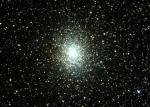
M19 appears to be a typical globular cluster of stars - except for its shape. If one looks closely at the cluster, pictured above, it appears to be longer (top to bottom) than it is wide.
|
January February March April May June July August September October |
|||||||||||||||||||||||||||||||||||||||||||||||||