
|
You entered: constellation
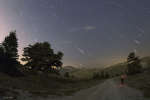 Perseid Meteors over Turkey
1.08.2017
The Perseid Meteor Shower, usually the best meteor shower of the year, will peak late next week. A person watching a clear sky from a dark location might see a bright meteor every minute.
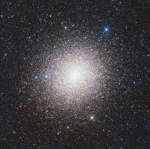 Globular Star Cluster 47 Tuc
10.03.2022
Globular star cluster 47 Tucanae is a jewel of the southern sky. Also known as NGC 104, it roams the halo of our Milky Way Galaxy along with some 200 other globular star clusters. The second brightest globular cluster (after Omega Centauri) as seen from planet Earth, 47 Tuc lies about 13,000 light-years away.
 APOD: 2025 September 25 Б Saturn Opposite the Sun
25.09.2025
This year Saturn was at opposition on September 21, opposite the Sun in planet Earth's sky. At its closest to Earth, Saturn was also at its brightest of the year, rising as the Sun set and shining above the horizon all night long among the fainter stars of the constellation Pisces.
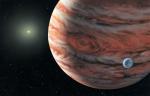 55 Cancri: Familiar Planet Discovered
14.06.2002
Is our Solar System unique? The discovery of a Jupiter-like planet in a Jupiter-like orbit around nearby Sun-like star 55 Cancri, announced yesterday, gives a new indication that planetary systems similar to our Solar System likely exist elsewhere. The planet, discovered by G.
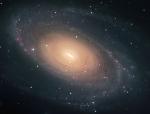 Bright Galaxy M81
20.06.2002
Big and beautiful spiral galaxy M81, in the northern constellation Ursa Major, is one of the brightest galaxies visible in the skies of planet Earth. This superbly detailed view reveals its bright nucleus, grand spiral arms and sweeping cosmic dust lanes with a scale comparable to the Milky Way.
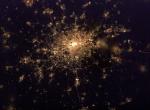 London at Night
11.04.2003
Do you recognize this intriguing globular cluster of stars? It's actually the constellation of city lights surrounding London, England, planet Earth, as recorded with a digital camera from the International Space Station. Taken in February 2003, north is toward the top and slightly left in this nighttime view.
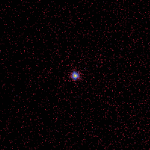 Sirius: The Brightest Star in the Night
2.09.1996
Sirius is the brightest star in the night sky. Intrinsically, Sirius is over 20 times brighter than our Sun and over twice as massive. As Sirius is 8.7 light years distant, it is not the closest star system -- the Alpha Centauri system holds this distinction.
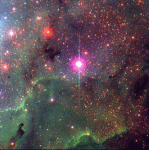 Starbirth in the Lagoon Nebula
24.10.1996
Stars are forming even today in the Lagoon Nebula. This bright nebula is visible in the constellation of Sagittarius with binoculars. The above photo is the result of a new sensitive camera being attached to one of the world's largest telescopes.
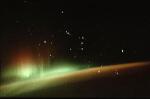 Aurora and Orion
26.01.1997
Looking toward the south from low Earth orbit, the crew of the Space Shuttle Endeavor made this stunning time exposure of the Aurora Australis or southern lights in April of 1994. Aurora are visible at high northern latitudes as well, with the northern lights known as Aurora Borealis.
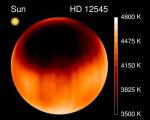 A Giant Starspot on HD 12545
2.11.2003
What could cause a star to have such a large spot? Our Sun itself frequently has sunspots, relatively cool dark magnetic depressions that move across its surface. HD 12545, however, exhibits the largest starspots yet observed.
|
January February March April May June July August September October |
|||||||||||||||||||||||||||||||||||||||||||||||||