
|
You entered: constellation
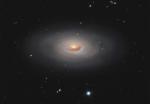 M64: The Black Eye Galaxy
2.08.2007
This bright, beautiful spiral galaxy is Messier 64, sometimes known as the Black Eye Galaxy. M64 lies about 17 million light-years distant in the otherwise well-groomed northern constellation Coma Bernices. The dark clouds along...
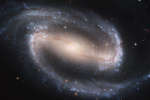 Barred Spiral Galaxy NGC 1300
22.06.2008
Big, beautiful, barred spiral galaxy NGC 1300 lies some 70 million light-years away on the banks of the constellation Eridanus. This Hubble Space Telescope composite view of the gorgeous island universe is one of the largest Hubble images ever made of a complete galaxy.
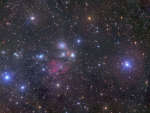 NGC 2170: Celestial Still Life
14.01.2009
Is this a painting or a photograph? In this beautiful celestial still life composed with a cosmic brush, dusty nebula NGC 2170 shines near the image center. Reflecting the light of nearby hot stars...
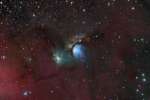 M78 Wide Field
26.11.2009
Interstellar dust clouds and glowing nebulae abound in the fertile constellation of Orion. One of the brightest, M78, is centered in this colorful, wide field view, covering an area north of Orion's belt. At a distance of about 1,500 light-years, the bluish reflection nebula is around 5 light-years across.
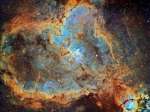 IC 1805: The Heart Nebula
4.03.2013
Sprawling across almost 200 light-years, emission nebula IC 1805 is a mix of glowing interstellar gas and dark dust clouds. Derived from its Valentine's-Day-approved shape, its nickname is the Heart Nebula. About 7,500 light-years away in the Perseus spiral arm of our galaxy, stars were born in IC 1805.
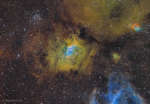 NGC 7635: Bubble in a Cosmic Sea
23.11.2016
Do you see the bubble in the center? Seemingly adrift in a cosmic sea of stars and glowing gas, the delicate, floating apparition in this widefield view is cataloged as NGC 7635 - The Bubble Nebula.
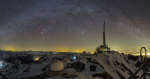 Pic du Midi Panorama
7.03.2020
A surreal night skyscape, this panorama stitched from 12 photos looks to the west at an evening winter sky over Pic du Midi Observatory, Pyrenees Mountains, Planet Earth. Telescope domes and a tall communications tower inhabit the rugged foreground.
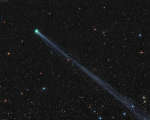 Long Tailed Comet SWAN
8.05.2020
Blowing in the solar wind the spectacular ion tail of Comet SWAN (C/2020 F8) extends far across this 10 degree wide telephoto field of view. Captured on May 2 its greenish coma was about 6 light-minutes from Earth. The pretty background starfield lies near the border of the constellations Cetus and Aquarius.
 A Cosmic Rose: NGC 2237 in Monoceros
14.02.2025
The Rosette Nebula, NGC 2237, is not the only cosmic cloud of gas and dust to evoke the imagery of flowers, but it is probably the most famous. At the edge of a large molecular cloud in Monoceros some 5,000 light years away, the petals of this cosmic rose are actually a stellar nursery.
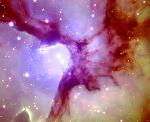 In the Center of the Trifid Nebula
26.06.2002
Clouds of glowing gas mingle with lanes of dark dust in the Trifid Nebula, a star forming region toward the constellation of Sagittarius. In the center, the three huge dark dust lanes that give the Trifid its name all come together.
|
January February March April May June July August September October |
|||||||||||||||||||||||||||||||||||||||||||||||||