
|
You entered: constellation
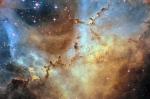 Dust Sculptures in the Rosette Nebula
6.06.2007
What creates the cosmic dust sculptures in the Rosette Nebula? Noted for the common beauty of its overall shape, parts of the Rosette Nebula, also known as NGC 2244, show beauty even when viewed up close.
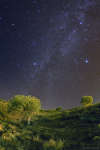 Summer Night in Astronomy Town
12.09.2009
This serene view records a late summer night sky over the rolling, green hills of planet Earth. It was taken near the rural village of Saadat Shahr, Fars province, in southern Iran. Saadat Shahr is also known as Astronomy Town, as the inhabitants have demonstrated a remarakble passion for sky gazing.
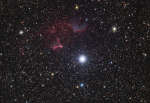 Gamma Cas and Friends
24.12.2009
Gamma Cassiopeiae shines high in northern autumn evening skies. The brightest spiky star in this rich and colorful Milky Way starfield, bluish Gamma Cas marks the central peak in the W-shaped constellation Cassiopeia.
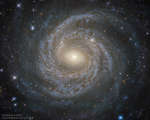 NGC 6814: Grand Design Spiral Galaxy from Hubble
21.06.2016
In the center of this serene stellar swirl is likely a harrowing black-hole beast. The surrounding swirl sweeps around billions of stars which are highlighted by the brightest and bluest. The breadth and beauty of the display give the swirl the designation of a grand design spiral galaxy.
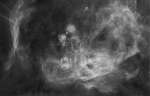 The Gum Nebula Expanse
24.05.2018
Named for a cosmic cloud hunter, Australian astronomer Colin Stanley Gum (1924-1960), The Gum Nebula is so large and close it is actually hard to see. In fact, we are only about 450 light-years from the front edge and 1,500 light-years from the back edge of this interstellar expanse of glowing hydrogen gas.
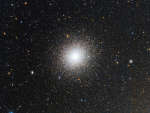 Globular Star Cluster 47 Tuc
24.10.2020
Globular star cluster 47 Tucanae is a jewel of the southern sky. Also known as NGC 104, it roams the halo of our Milky Way Galaxy along with some 200 other globular star clusters.
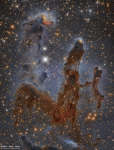 Pillars of the Eagle Nebula in Infrared
7.03.2021
Newborn stars are forming in the Eagle Nebula. Gravitationally contracting in pillars of dense gas and dust, the intense radiation of these newly-formed bright stars is causing surrounding material to boil away. This image...
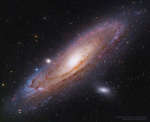 M31: The Andromeda Galaxy
19.01.2022
The most distant object easily visible to the unaided eye is M31, the great Andromeda Galaxy. Even at some two and a half million light-years distant, this immense spiral galaxy -- spanning over 200,000 light years -- is visible, although as a faint, nebulous cloud in the constellation Andromeda.
 A Filament in Monoceros
18.03.2022
Bluish reflection nebulae seem to fill this dusty expanse. The sharp telescopic frame spans over 1 degree on the sky toward the faint but fanciful constellation Monoceros, the Unicorn. Seen within the Monoceros...
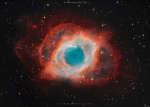 NGC 7293: The Helix Nebula
7.12.2022
A mere seven hundred light years from Earth, toward the constellation Aquarius, a sun-like star is dying. The dying star's last few thousand years have produced the Helix Nebula (NGC 7293), a well studied and nearby example of a Planetary Nebula, typical of this final phase of stellar evolution.
|
January February March April May June July August September October |
|||||||||||||||||||||||||||||||||||||||||||||||||