
|
You entered: constellation
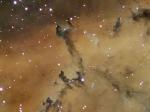 Dust Sculptures in the Rosette Nebula
10.01.2005
What creates the cosmic dust sculptures in the Rosette Nebula? Noted for the common beauty of its overall shape, parts of the Rosette Nebula, also known as NGC 2244, show beauty even when viewed up close.
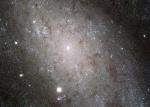 The Stars of NGC 300
20.08.2005
Like grains of sand on a cosmic beach, individual stars of large spiral galaxy NGC 300 are resolved in this sharp image from the Hubble Space Telescope's Advanced Camera for Surveys (ACS). The inner region of the galaxy is pictured, spanning about 7,500 light-years.
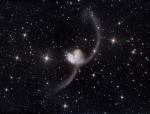 The Antennae
30.06.2006
Some 60 million light-years away in the southerly constellation Corvus, two large galaxies have collided. But stars in the two galaxies - NGC 4038 and NGC 4039 - don't collide in the course of the ponderous, billion year or so long event.
 Collinder 399: The Coat Hanger
12.01.2007
Is this coat hanger a star cluster or an asterism? This cosmic hang-up has been debated over much of last century, as astronomers wondered whether this binocular-visible object is really a physically associated open cluster or a chance projection. Chance star projections are known as asterisms, an example of which is the popular Big Dipper.
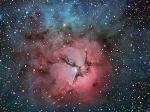 The Trifid Nebula in Stars and Dust
13.08.2007
Unspeakable beauty and unimaginable bedlam can be found together in the Trifid Nebula. Also known as M20, this photogenic nebula is visible with good binoculars towards the constellation of Sagittarius. The energetic processes of star formation create not only the colors but the chaos. The red-glowing gas results from high-energy starlight striking interstellar hydrogen gas.
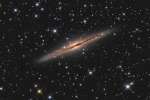 Edge on Spiral Galaxy NGC 891
25.02.2010
This beautiful cosmic portrait features NGC 891. The spiral galaxy spans about 100 thousand light-years and is seen almost exactly edge-on from our perspective. In fact, about 30 million light-years distant in the constellation Andromeda, NGC 891 looks a lot like our Milky Way.
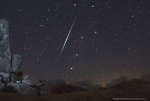 Meteor in the Desert Sky
11.12.2010
Created as planet Earth sweeps through dusty debris from mysterious, asteroid-like, 3200 Phaethon, the annual Geminid Meteor Shower should be the best meteor shower of the year. The Geminids are predicted to peak on the night of December 13/14, but you can start watching for Geminid meteors this weekend.
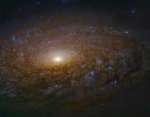 NGC 3521 Close Up
13.01.2011
Gorgeous spiral galaxy NGC 3521 is a mere 35 million light-years distant, toward the constellation Leo. Spanning some 50,000 light-years, its central region is shown in this dramatic image, constructed from data drawn from the Hubble Legacy Archive.
 The Little Dipper
14.05.2011
At 2nd magnitude, Polaris is far from the brightest star in the night sky. But it is the brightest star at the left of this well-composed, starry mosaic spanning about 23 degrees across the northern sky asterism dubbed the Little Dipper.
 M78: Stardust and Starlight
10.10.2013
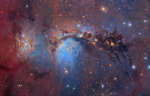
Interstellar dust clouds and bright nebulae abound in the fertile constellation of Orion. One of the brightest, M78, is just left of center in this colorful telescopic view, covering an area north of Orion's belt. At a distance of about 1,500 light-years, the bluish nebula itself is about 5 light-years across.
|
January February March April May June July August September October |
|||||||||||||||||||||||||||||||||||||||||||||||||