
|
You entered: constellation
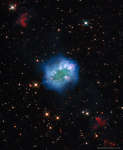 Jets from the Necklace Nebula
18.05.2021
What celestial body wears the Necklace Nebula? First, analyses indicate that the Necklace is a planetary nebula, a gas cloud emitted by a star toward the end of its life. Also, what appears to be diamonds in the Necklace are actually bright knots of glowing gas.
 Jupiter and the Geminid
28.12.2023
For a brief moment, this brilliant fireball meteor outshone Jupiter in planet Earth's night. The serendipitous image was captured while hunting meteors under cold Canadian skies with a camera in timelapse mode on December 14, near the peak of the Geminid meteor shower.
 APOD: 2024 December 15 Б Geminid Meteors over a Snowy Forest
15.12.2024
Meteors have been flowing out from the constellation Gemini. This was expected, as mid-December is the time of the Geminid Meteor Shower. Pictured here, over two dozen meteors were caught in successively added exposures taken over several hours early Saturday morning from a snowy forest in Poland.
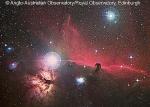 Orion's Horsehead Nebula
27.08.2000
The Horsehead Nebula is one of the most famous nebulae on the sky. It is visible as the black indentation to the red emission nebula seen just to the right of center of the above photograph. The bright star near the center is located in the belt of the familiar constellation of Orion.
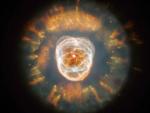 The Eskimo Nebula from Hubble
7.04.2002
In 1787, astronomer William Herschel discovered the Eskimo Nebula. From the ground, NGC 2392 resembles a person's head surrounded by a parka hood. In 2000, the Hubble Space Telescope imaged the Eskimo Nebula. From space, the nebula displays gas clouds so complex they are not fully understood.
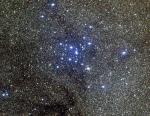 The M7 Open Star Cluster in Scorpius
5.05.2002
M7 is one of the most prominent open clusters of stars on the sky. The cluster, dominated by bright blue stars, can be seen with the naked eye in a dark sky in the tail of the constellation of Scorpius.
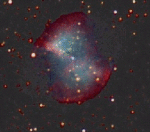 M27: The Dumbbell Nebula
29.07.1995
The Dumbbell Nebula is a beautiful red and blue planetary nebula in the constellation of Vulpecula. It is the 27th object on Charles Messier's list of diffuse sky objects, and so is referred to as M27. Its high surface brightness makes it a good target for small telescopes.
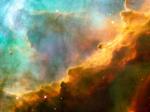 M17: A Hubble Close Up
25.04.2003
Sculpted by stellar winds and radiation, these fantastic, undulating shapes lie within the stellar nursery known as M17, the Omega Nebula, some 5,500 light-years away in the nebula-rich constellation Sagittarius. The lumpy features...
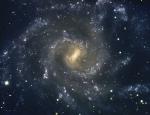 The Arms of NGC 7424
16.12.2004
The grand, winding arms are almost mesmerizing in this face-on view of NGC 7424, a spiral galaxy with a prominent central bar. About 40 million light-years distant in the headlong constellation Grus, this island universe is also about 100,000 light-years across making it remarkably similar to our own Milky Way.
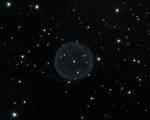 Spherical Planetary Nebula Abell 39
28.07.2005
Ghostly in appearance, Abell 39 is a remarkably simple, spherical nebula about five light-years across. Well within our own Milky Way galaxy, the cosmic sphere is roughly 7,000 light-years distant toward the constellation Hercules.
|
January February March April May June July August September October |
|||||||||||||||||||||||||||||||||||||||||||||||||