
|
You entered: constellation
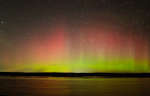 Nova Scotia Northern Lights
2.04.2022
This almost otherworldly display of northern lights was captured in clear skies during the early hours of March 31 from 44 degrees north latitude, planet Earth. In a five second exposure the scene looks north from Martinique Beach Provincial Park in Nova Scotia, Canada.
 APOD: 2023 October 30 Б Reflections of the Ghost Nebula
30.10.2023
Do any shapes seem to jump out at you from this interstellar field of stars and dust? The jeweled expanse, filled with faint, starlight-reflecting clouds, drifts through the night in the royal constellation of Cepheus.
 Star Factory Messier 17
29.08.2024
A nearby star factory known as Messier 17 lies some 5,500 light-years away in the nebula-rich constellation Sagittarius. At that distance, this 1.5 degree wide field-of-view would span about 150 light-years.
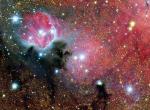 East of the Lagoon Nebula
20.05.2002
To the east of the Lagoon Nebula is a star field rich in diversity. On the lower left are clouds rich in dark dust that hide background stars and young star systems still forming. Dark clouds include LDN 227 on the left and IC 1275 on the right, with a bright star near its tip.
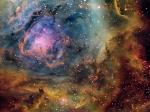 The Busy Center of the Lagoon Nebula
3.08.2005
Stars are battling gas and dust in the Lagoon Nebula but the photographers are winning. Also known as M8, this photogenic nebula is visible even without binoculars towards the constellation of Sagittarius. The energetic processes of star formation create not only the colors but the chaos.
 Light from the Heart Nebula
3.10.2006
What powers the Heart Nebula? The large emission nebula dubbed IC 1805 looks, in whole, like a human heart. The nebula glows brightly in red light emitted by its most prominent element: hydrogen. The red glow and the larger shape are all created by a small group of stars near the nebula's center.
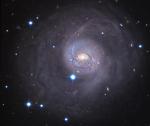 The Outskirts of M77
7.12.2006
Face-on spiral galaxy M77 lies a mere 60 million light-years away toward the constellation Cetus. Also known as NGC 1068, it's very bright core is well studied by astronomers exploring the mysteries of supermassive black holes in active galaxies.
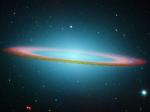 The Sombrero Galaxy in Infrared
21.01.2007
This floating ring is the size of a galaxy. In fact, it is part of the photogenic Sombrero Galaxy, one of the largest galaxies in the nearby Virgo Cluster of Galaxies. The dark band of dust that obscures the mid-section of the Sombrero Galaxy in optical light actually glows brightly in infrared light.
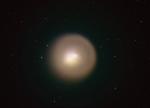 Golden Comet Holmes
3.11.2007
Surprising Comet Holmes remains easily visible as a round, fuzzy cloud in the northern constellation Perseus. Skywatchers with telescopes, binoculars, or those that just decide to look up can enjoy the solar system's latest prodigy as it glides about 150 million kilometers from Earth, beyond the orbit of Mars.
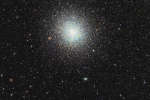 47 Tuc: A Great Globular Cluster of Stars
26.08.2008
Stars come in bunches. Of the over 200 globular star clusters that orbit the center of our Milky Way Galaxy, 47 Tucanae is the second brightest globular cluster (behind Omega Centauri). Light takes about...
|
January February March April May June July August September October |
|||||||||||||||||||||||||||||||||||||||||||||||||