
|
You entered: constellation
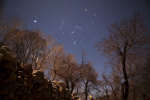 A Geminid Meteor Over Iran
19.12.2011
Some beautiful things begin as grains of sand. Locked in an oyster, a granule grows into an iridescent pearl, lustrous and lovely to behold. While hurtling through the atmosphere at 35 kilometers per second, a generous cosmic sand grain becomes an awe-inspiring meteor, its transient beauty displayed for any who care to watch.
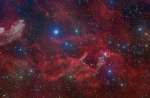 NGC 1788 and the Witch s Whiskers
19.04.2013
This skyscape finds an esthetic balance of interstellar dust and gas residing in the suburbs of the nebula rich constellation of Orion. Reflecting the light of bright star Rigel, Beta Orionis, the jutting, bluish chin of the Witch Head Nebula is at the upper left.
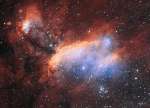 IC 4628: The Prawn Nebula
23.09.2013
South of Antares, in the tail of the nebula-rich constellation Scorpius, lies emission nebula IC 4628. Nearby hot, massive stars, millions of years young, radiate the nebula with invisible ultraviolet light, stripping electrons from atoms. The electrons eventually recombine with the atoms to produce the visible nebular glow, dominated by the red emission of hydrogen.
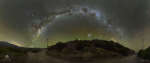 Puzzling a Sky over Argentina
25.07.2016
Can you find the comet? True, a careful eye can find thousands of stars, tens of constellations, four planets, three galaxies, and the central band of our Milky Way Galaxy -- all visible in the sky of this spectacular 180-degree panorama.
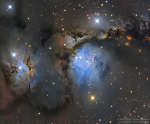 M78 and Orion Dust Reflections
23.01.2017
In the vast Orion Molecular Cloud complex, several bright blue nebulas are particularly apparent. Pictured here are two of the most prominent reflection nebulas - dust clouds lit by the reflecting light of bright embedded stars. The more famous nebula is M78, in the image center, cataloged over 200 years ago.
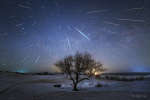 Gemini s Meteors
21.12.2017
From dark skies above Heilongjiang province in northeastern China, meteors rain down on a wintry landscape in this beautiful composited night scene. The 48 meteors are part of last week's annual Geminid meteor shower.
 NGC 1365: Majestic Island Universe
27.12.2018
Barred spiral galaxy NGC 1365 is truly a majestic island universe some 200,000 light-years across. Located a mere 60 million light-years away toward the chemical constellation Fornax, NGC 1365 is a dominant member of the well-studied Fornax galaxy cluster.
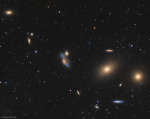 Markarians Chain of Galaxies
30.03.2019
Across the heart of the Virgo Cluster of Galaxies lies a striking string of galaxies known as Markarian's Chain. The chain, pictured here, is highlighted on the right with two large but featureless lenticular galaxies, M84 and M86. Prominent to their lower left is a pair of interacting galaxies known as The Eyes.
 Young Stars, Stellar Jets
27.07.2023
High-speed outflows of molecular gas from a pair of actively forming young stars shine in infrared light, revealing themselves in this NIRcam image from the James Webb Space Telescope. Cataloged as HH (Herbig-Haro) 46/47, the young stars are lodged within a dark nebula that is largely opaque when viewed in visible light.
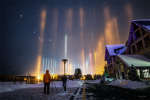 APOD: 2026 March 23 Б Light Pillars and Orion over Mohe
22.03.2026
What's happening at the end of that street? Pictured here are not auroras but light pillars, a phenomenon typically much closer. In most places on Earth, a lucky viewer...
|
January February March April May June July August September October |
|||||||||||||||||||||||||||||||||||||||||||||||||