
|
You entered: constellation
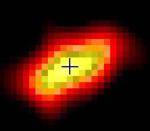 HR 4796A: A Recipe for Planets
22.04.1998
Two hundred and twenty light years from Earth, planets are forming. Recent observations of the binary star system HR 4796 have shown that one of the stars is surrounded by a dusty gaseous disk. This disk is of the right size, age, and density for dust pellets to accrete surrounding matter.
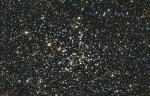 Open Star Cluster M38
6.01.2003
Open cluster M38 can be seen with binoculars toward the constellation of Auriga. M38 is considered an intermediately rich open cluster of stars, each of which is about 200 million years old. Located...
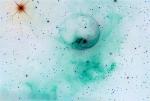 The Bubble Nebula from NOAO
17.06.2003
It's the bubble versus the cloud. NGC 7635, the Bubble Nebula, is being pushed out by the stellar wind of massive central star BD+602522. Next door, though, lives a giant molecular cloud, visible above to the lower right.
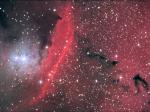 In the Center of NGC 6559
29.06.2004
Bright gas and dark dust permeate the space between stars in the center of a nebula known as NGC 6559. The gas, primarily hydrogen, is responsible for the diffuse red glow of the emission nebula.
 The Witch Head Nebula
29.08.1999
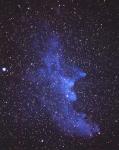
Double, double toil and trouble; Fire burn, and cauldron bubble ... Maybe Macbeth should have consulted the Witch Head Nebula. This suggestively shaped reflection nebula is associated with the bright star Rigel in the constellation Orion. More formally known as IC 2118, the Witch Head Nebula glows primarily by light reflected from Rigel.
 This Comet Lovejoy
24.12.2014
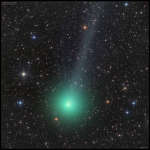
Comet Lovejoy, C/2014 Q2, is framed like a cosmic Christmas tree with starry decorations in this colorful telescopic portrait, snapped on December 16th. Its lovely coma is tinted green by diatomic C2 gas fluorescing in sunlight.
 Infrared Trifid
24.07.2015
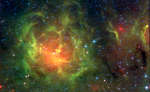
The Trifid Nebula, also known as Messier 20, is easy to find with a small telescope, a well known stop in the nebula rich constellation Sagittarius. But where visible light pictures show the nebula...
 Galaxies in Pegasus
2.12.2016
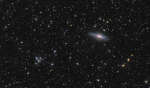
This wide, sharp telescopic view reveals galaxies scattered beyond the stars of the Milky Way at the northern boundary of the high-flying constellation Pegasus. Prominent at the upper right is NGC 7331. A mere...
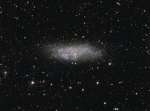 Wolf Lundmark Melotte
18.05.2017
Named for the three astronomers instrumental in its discovery and identification, Wolf - Lundmark - Melotte (WLM) is a lonely dwarf galaxy. Seen toward the mostly southern constellation Cetus, about 3 million light-years from the Milky Way, it is one of the most remote members of our local galaxy group.
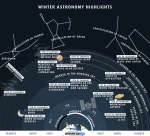 Highlights of the Winter Sky
11.12.2017
What's up in the sky this winter? The featured graphic gives a few highlights for Earth's northern hemisphere. Viewed as a clock face centered at the bottom, early winter sky events fan out toward the left, while late winter events are projected toward the right.
|
January February March April May June July August September October |
|||||||||||||||||||||||||||||||||||||||||||||||||