
|
You entered: constellation
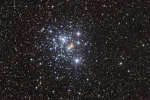 NGC 4755: A Jewel Box of Stars
17.08.2010
The great variety of star colors in this open cluster underlies its name: The Jewel Box. One of the bright central stars is a red supergiant, in contrast to the many blue stars that surround it. The cluster, also known as Kappa Crucis contains just over 100 stars, and is about 10 million years old.
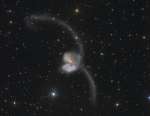 The Antennae
29.04.2011
Some 60 million light-years away in the southerly constellation Corvus, two large galaxies collided. But the stars in the two galaxies, cataloged as NGC 4038 and NGC 4039, don't collide in the course of the ponderous event, lasting hundreds of millions of years.
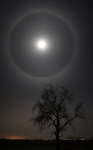 A February Moon Halo
11.02.2012
Lighting the night last Tuesday, February's Full Moon is sometimes called the Snow Moon. But the Moon was not quite full in this mosaicked skyscape recorded on February 2 south of Budapest, Hungary, and there was no snow either.
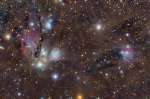 NGC 2170: Celestial Still Life
14.01.2013
In this celestial still life composed with a cosmic brush, dusty nebula NGC 2170 shines left of image center. Reflecting the light of nearby hot stars, NGC 2170 is joined by other bluish reflection nebulae, a red emission region, many dark absorption nebulae, and a backdrop of colorful stars.
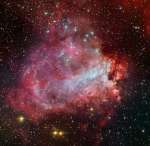 Star Factory Messier 17
22.10.2015
Sculpted by stellar winds and radiation, the star factory known as Messier 17 lies some 5,500 light-years away in the nebula-rich constellation Sagittarius. At that distance, this 1/3 degree wide field of view spans over 30 light-years.
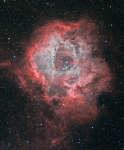 A Cosmic Rose: The Rosette Nebula in Monoceros
12.04.2019
The Rosette Nebula, NGC 2237, is not the only cosmic cloud of gas and dust to evoke the imagery of flowers, but it is the most famous. At the edge of a large molecular cloud in Monoceros some 5,000 light years away, the petals of this cosmic rose are actually a stellar nursery.
 APOD: 2025 February 11 Б The Spider and the Fly
11.02.2025
Will the spider ever catch the fly? Not if both are large emission nebulas toward the constellation of the Charioteer (Auriga). The spider-shaped gas cloud in the image center is actually an emission nebula...
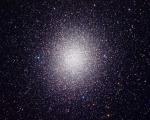 Millions of Stars in Omega Centauri
16.04.2002
Pictured above is the largest ball of stars in our Galaxy. About 10 million stars orbit the center of this globular cluster - named Omega Centauri - as this giant globular cluster orbits our Galactic center.
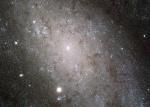 The Stars of NGC 300
16.04.2004
Like grains of sand on a cosmic beach, individual stars of large spiral galaxy NGC 300 are resolved in this sharp image from the Hubble Space Telescope's Advanced Camera for Surveys (ACS).
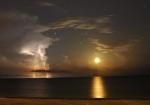 Moon Lightning
7.10.2004
Moonsets are not often quite as exciting as this one. But amateur astronomer Marc-Andre Besel was impressed by the brilliant lighting displays that joined the first quarter Moon and stars of the constellation Scorpius in western skies.
|
January February March April May June July August September October |
|||||||||||||||||||||||||||||||||||||||||||||||||