
|
You entered: constellation
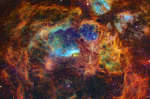 NGC 6357: The Lobster Nebula
28.10.2020
Why is the Lobster Nebula forming some of the most massive stars known? No one is yet sure. Cataloged as NGC 6357, the Lobster Nebula houses the open star cluster Pismis 24 near its center -- a home to unusually bright and massive stars.
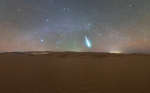 Gemind of the North
17.12.2021
An arid expanse of the Tengger Desert in north-central China, planet Earth fills the foreground of this starry scene. A widefield panoramic view, it was recorded shortly after moonset in the local predawn hours of December 14. Pictured in the still dark sky, stars of the northern winter hexagon surround a luminous Milky Way.
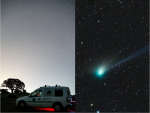 Naked Eye Comet ZTF
21.01.2023
Comet C/2022E3 (ZTF) is no longer too dim to require a telescope for viewing. By January 19, it could just be seen with the naked eye in this rural sky with little light pollution from a location about 20 kilometers from Salamanca, Spain.
 The Double Cluster in Perseus
7.07.2023
This pretty starfield spans about three full moons (1.5 degrees) across the heroic northern constellation of Perseus. It holds the famous pair of open star clusters, h and Chi Persei. Also cataloged...
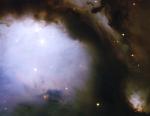 Reflection Nebula M78
11.02.2002
An eerie blue glow and ominous columns of dark dust highlight M78, one of the brightest reflection nebula on the sky. M78 is visible with a small telescope toward the constellation of Orion. The dust not only absorbs light, but also reflects the light of several bright blue stars that formed recently in the nebula.
 Clearing Skies
26.07.2002
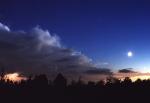
Clear evening skies are a welcome sight for stargazers worldwide, but clearing skies are good too. Just such a glorious occasion was recorded in this dramatic photo taken by Dominic Cantin during a recent gathering of Canadian astronomers at St-NИrИe Observatory, located about 60 kilometers southeast of the city of Quebec.
 Giant Emission Nebula NGC 3603 in Infrared
14.08.2002
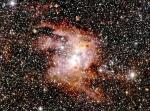
NGC 3603 is the largest region of glowing gas in our Milky Way galaxy. Spanning over 20 light years across, the giant emission nebula (HII region) is home to a massive star cluster, thick dust pillars, and a star about to explode.
 Bright Comet SOHO
21.05.1998
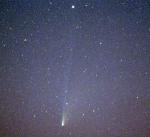
Discovered this month with an orbiting solar observatory, bright Comet SOHO has now emerged from the Sun's glare. This telephoto picture of the new naked-eye comet was taken by astrophotographer Michael Horn after sunset in the western twilight above Lake Samsonvale, Brisbane, Australia on May 18. The comet is seen in the constellation Orion.
 IC 4592: The Blue Horsehead Reflection Nebula
2.04.2013
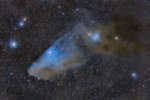
Do you see the horse's head? What you are seeing is not the famous Horsehead nebula toward Orion but rather a fainter nebula that only takes on a familiar form with deeper imaging. The main part of the above imaged molecular cloud complex is a reflection nebula cataloged as IC 4592.
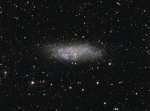 Wolf-Lundmark-Melotte
7.04.2016
Named for the three astronomers instrumental in its discovery and identification, Wolf - Lundmark - Melotte (WLM) is a lonely dwarf galaxy. Seen toward the mostly southern constellation Cetus, about 3 million light-years from the Milky Way, it is one of the most remote members of our local galaxy group.
|
January February March April May June July August September October |
|||||||||||||||||||||||||||||||||||||||||||||||||