
|
You entered: constellation
 An Almost Total Lunar Eclipse
20.11.2021
Predawn hours of November 19 found the Moon in partly cloudy skies over Cancun, Mexico. Captured in this telephoto snapshot, the lunar disk is not quite entirely immersed in Earth's dark umbral shadow during a long partial lunar eclipse.
 APOD: 2023 April 8 Б M100: A Grand Design Spiral Galaxy
8.04.2023
Majestic on a truly cosmic scale, M100 is appropriately known as a grand design spiral galaxy. It is a large galaxy of over 100 billion stars with well-defined spiral arms that is similar to our own Milky Way Galaxy.
 Ghirigori Star Scribbles
12.08.2023
It's fun to scribble on the canvas of the sky. You can use a creative photographic technique to cause the light of point-like stars to dance across a digital image by tapping lightly on the telescope while making an exposure.
 APOD: 2023 September 26 Б IC 4592: The Blue Horsehead Reflection Nebula
26.09.2023
Do you see the horse's head? What you are seeing is not the famous Horsehead nebula toward Orion, but rather a fainter nebula that only takes on a familiar form with deeper imaging. The main part of the here-imaged molecular cloud complex is reflection nebula IC 4592.
 APOD: 2024 March 13 Б The Seagull Nebula
13.03.2024
A broad expanse of glowing gas and dust presents a bird-like visage to astronomers from planet Earth, suggesting its popular moniker: the Seagull Nebula. This portrait of the cosmic bird covers a 1.6-degree...
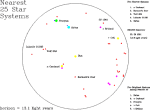 The Nearest Stars
18.03.2001
Which stars are closest to the Sun? The closest is Proxima Centauri, one of three stars that orbit each other about 4 light-years away in the Alpha-Centauri system. Alpha Centauri is easily visible from Earth's
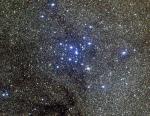 The M7 Open Star Cluster in Scorpius
22.02.2004
M7 is one of the most prominent open clusters of stars on the sky. The cluster, dominated by bright blue stars, can be seen with the naked eye in a dark sky in the tail of the constellation of Scorpius.
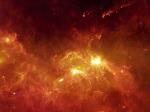 Orion in Infrared
19.04.2005
Do you recognize the constellation Orion? This striking but unfamiliar looking picture of the familiar Orion region of the sky was produced using survey data from the now-defunct InfraRed Astronomical Satellite (IRAS). The above image combines information recorded at three different invisible infrared wavelengths and covers about 30x24 degrees on the sky.
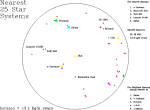 The Nearest Stars
21.04.1999
Which stars are closest to the Sun? The closest is Proxima Centauri, one of three stars that orbit each other about 4 light-years away in the Alpha-Centauri system. Alpha Centauri is easily visible from Earth's Southern Hemisphere. Next is Barnard's Star, a dim star visible with a telescope in the constellation of Ophiuchus.
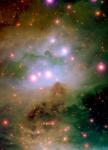 The Colorful Orion Nebula
14.09.1999
The Great Nebula in Orion is a colorful place. Visible to the unaided eye as a fuzzy patch in the constellation of Orion, this image taken with the Big Throughput Camera shows the Orion Nebula to be a busy neighborhood of young stars, hot gas, and dark dust.
|
January February March April May June July August September October |
|||||||||||||||||||||||||||||||||||||||||||||||||