
|
You entered: constellation
 NGC 6822: Barnard s Galaxy
2.12.2021
Grand spiral galaxies often seem to get all the glory, flaunting their young, bright, blue star clusters in beautiful, symmetric spiral arms. But small galaxies form stars too, like nearby NGC 6822, also known as Barnard's Galaxy.
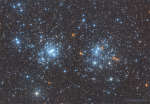 A Double Star Cluster in Perseus
22.11.2022
Few star clusters this close to each other. Visible to the unaided eye from dark sky areas, it was cataloged in 130 BC by Greek astronomer Hipparchus. Some 7,000 light-years away, this pair...
 Irregular Dwarf Galaxy Sextans A
29.05.2025
Grand spiral galaxies often seem to get all the attention, flaunting young, bright, blue star clusters and pinkish star forming regions along graceful, symmetric spiral arms. But small galaxies form stars too, like irregular dwarf galaxy Sextans A.
 APOD: 2025 August 7 Б The Double Cluster in Perseus
7.08.2025
This stunning starfield spans about three full moons (1.5 degrees) across the heroic northern constellation of Perseus. It holds the famous pair of open star clusters, h and Chi Persei. Also cataloged...
 APOD: 2025 August 29 Б A Dark Veil in Ophiuchus
29.08.2025
The diffuse hydrogen-alpha glow of emission region Sh2-27 fills this cosmic scene. The field of view spans nearly 3 degrees across the nebula-rich constellation Ophiuchus toward the central Milky Way. A Dark Veil...
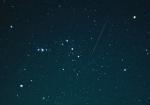 A 2000 Leonid Through Orion
20.11.2000
The Leonid Meteor Shower this year could be described as good but not great. During November 17 and 18 the Earth crossed through several streams of sand-sized grit left orbiting the Sun by Comet Tempel-Tuttle. Several distinct peaks in meteor activity were reported, with
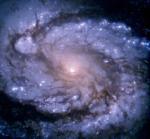 M100: A Grand Design
3.02.2001
Majestic on a truly cosmic scale, M100 is appropriately known as a Grand Design spiral galaxy. A large galaxy of over 100 billion or so stars with well defined spiral arms, it is similar to our own Milky Way.
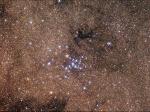 The M7 Open Star Cluster in Scorpius
6.04.2005
M7 is one of the most prominent open clusters of stars on the sky. The cluster, dominated by bright blue stars, can be seen with the naked eye in a dark sky in the tail of the constellation of Scorpius.
 Amazing Comet Holmes
24.10.2008
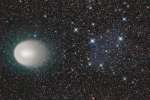
One year ago, Comet 17P/Holmes amazed sky watchers across planet Earth. A stunningly rapid outburst transformed it from a faint comet quietly orbiting the Sun with a period of about 7 years to a naked-eye comet rivaling the brighter stars in the constellation Perseus.
 Starburst Galaxy IC 10
9.10.2009
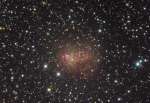
Lurking behind dust and stars near the plane of our Milky Way Galaxy, IC 10 is a mere 2.3 million light-years distant. Its light dimmed by the intervening dust, the irregular dwarf galaxy still shows off vigorous star-forming regions that shine with a telltale reddish glow in this colorful skyscape.
|
January February March April May June July August September October |
|||||||||||||||||||||||||||||||||||||||||||||||||