
|
You entered: constellation
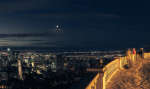 Morning, Planets, Moon, and Montreal
20.03.2020
Dawn's early light came to Montreal, northern planet Earth, on March 18, the day before the vernal equinox. At the end of that nearly equal night the Moon stands above a dense constellation of urban lights in this serene city and skyscape. Of course the Moon's waning crescent faces toward the rising Sun.
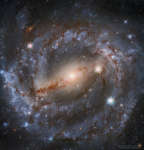 NGC 5643: Nearby Spiral Galaxy from Hubble
5.10.2020
What's happening at the center of spiral galaxy NGC 5643? A swirling disk of stars and gas, NGC 5643's appearance is dominated by blue spiral arms and brown dust, as shown in the featured image taken by the Hubble Space Telescope.
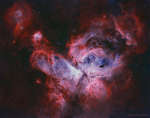 The Great Nebula in Carina
25.04.2022
In one of the brightest parts of Milky Way lies a nebula where some of the oddest things occur. NGC 3372, known as the Great Nebula in Carina, is home to massive stars and changing nebulas. The Keyhole Nebula (NGC 3324), the bright structure just below the image center, houses several of these massive stars.
 APOD: 2024 November 18 Б Stars and Dust in the Pacman Nebula
18.11.2024
Stars can create huge and intricate dust sculptures from the dense and dark molecular clouds from which they are born. The tools the stars use to carve their detailed works are high energy light and fast stellar winds.
 APOD: 2025 September 5 Б 47 Tucanae: Globular Star Cluster
5.09.2025
Also known as NGC 104, 47 Tucanae is a jewel of the southern sky. Not a star but a dense cluster of stars, it roams the halo of our Milky Way Galaxy along with some 200 other globular star clusters.
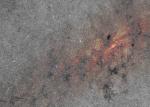 The Galactic Center in Infrared
8.07.2001
The center of our Galaxy is a busy place. In visible light, much of the Galactic Center is obscured by opaque dust. In infrared light, however, dust glows more and obscures less, allowing nearly one million stars to be recorded in the above photograph.
 Hen 1357: New Born Nebula
3.04.1998
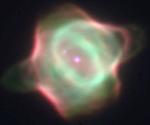
This Hubble Space Telescope picture shows Hen-1357, the youngest known planetary nebula. Graceful, gentle curves and symmetry suggest its popular name - The Stingray Nebula. Observations in the 1970s detected no nebular material, but this image from March 1996 clearly shows the Stingray's emerging bubbles and rings of shocked and ionized gas.
 The Galactic Center in Infrared
7.11.2004
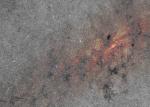
The center of our Galaxy is a busy place. In visible light, much of the Galactic Center is obscured by opaque dust. In infrared light, however, dust glows more and obscures less, allowing nearly one million stars to be recorded in the above photograph.
 The Fox Fur Nebula
14.03.2005
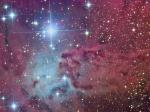
The nebula surrounding bright star S Mon is filled with dark dust and glowing gas. The strange shapes originate from fine interstellar dust reacting in complex ways with the energetic light and hot gas being expelled by the young stars.
 NGC 4565: Galaxy on the Edge
8.07.2005
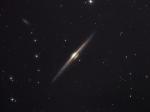
Magnificent spiral galaxy NGC 4565 is viewed edge-on from planet Earth. Also known as the Needle Galaxy for its narrow profile, bright NGC 4565 is a stop on many telescopic tours of the northern sky as it lies in the faint but well-groomed constellation Coma Berenices.
|
January February March April May June July August September October |
|||||||||||||||||||||||||||||||||||||||||||||||||