
|
You entered: constellation
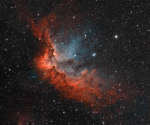 NGC 7380: The Wizard Nebula
2.11.2011
What powers are being wielded in the Wizard Nebula? Gravitation strong enough to form stars, and stellar winds and radiations powerful enough to create and dissolve towers of gas. Located only 8,000 light years away, the Wizard nebula, pictured above, surrounds developing open star cluster NGC 7380.
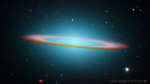 The Sombrero Galaxy in Infrared
3.10.2015
This floating ring is the size of a galaxy. In fact, it is a galaxy -- or at least part of one: the photogenic Sombrero Galaxy, one of the largest galaxies in the nearby Virgo Cluster of Galaxies.
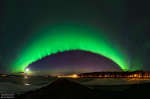 Aurora over Sweden
2.05.2016
It was bright and green and stretched across the sky. This striking aurora display was captured last month just outside of жstersund, Sweden. Six photographic fields were merged to create the featured panorama spanning almost 180 degrees. Particularly striking aspects of this aurora include its sweeping arc-like shape and its stark definition.
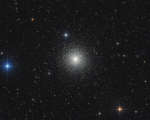 M15: Dense Globular Star Cluster
16.10.2018
Messier 15 is an immense swarm of over 100,000 stars. A 13 billion year old relic of the early formative years of our galaxy it's one of about 170 globular star clusters that still roam the halo of the Milky Way.
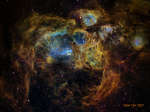 NGC 6357: The Lobster Nebula
25.12.2018
Why is the Lobster Nebula forming some of the most massive stars known? No one is yet sure. Cataloged as NGC 6357, the Lobster Nebula houses the open star cluster Pismis 24 near its center -- a home to unusually bright and massive stars.
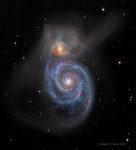 M51: The Whirlpool Galaxy
1.09.2021
Find the Big Dipper and follow the handle away from the dipper's bowl until you get to the last bright star. Then, just slide your telescope a little south and west and you'll come upon this stunning pair of interacting galaxies, the 51st entry in Charles Messier's famous catalog.
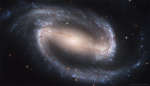 Barred Spiral Galaxy NGC 1300
15.10.2022
Across the center of this spiral galaxy is a bar. And at the center of this bar is smaller spiral. And at the center of that spiralбis a supermassiveбblack hole.б This all happens...
 Globular Star Cluster 47 Tuc
7.02.2024
Globular star cluster 47 Tucanae is a jewel of the southern sky. Also known as NGC 104, it roams the halo of our Milky Way Galaxy along with some 200 other globular star clusters. The second brightest globular cluster (after Omega Centauri) as seen from planet Earth, 47 Tuc lies about 13,000 light-years away.
 Structure in the Tail of Comet 12P/Pons Brooks
15.02.2024
Heading for its next perihelion passage on April 21, Comet 12P/Pons-Brooks is growing brighter. The greenish coma of this periodic Halley-type comet has become relatively easy to observe in small telescopes. But the bluish...
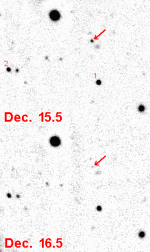 Gamma-ray Burster
17.12.1997
Gamma-ray bursts seem to be the most powerful explosions in the Universe. Yet their sources continue to elude researchers who stand in awe and frustration at the bursts' transient, enigmatic behavior. The blinking gif above illustrates the latest hard-won result in the quest to identify and understand the nature of the bursters.
|
January February March April May June July August September October |
|||||||||||||||||||||||||||||||||||||||||||||||||