
|
You entered: constellation
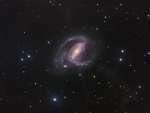 The Jets of NGC 1097
27.11.2009
Enigmatic spiral galaxy NGC 1097 lies about 45 million light-years away in the southern constellation Fornax. The small companion galaxy, just below and left of center, that seems to be wrapped in its spiral arms, is not NGC 1097's most peculiar feature though.
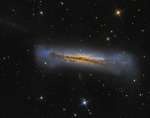 Edge on NGC 3628
4.11.2011
Sharp telescopic views of magnificent edge-on spiral galaxy NGC 3628 show a puffy galactic disk divided by dark dust lanes. The tantalizing scene puts many astronomers in mind of its popular moniker, The Hamburger Galaxy.
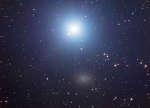 Bright Star Regulus near the Leo I Dwarf Galaxy
10.01.2012
The star near the top is so bright that it is sometimes hard to notice the galaxy toward the bottom. Pictured above, both the star, Regulus, and the galaxy, Leo I, can be found within one degree of each other toward the constellation of the Lion (Leo).
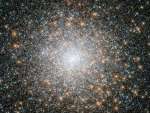 Globular Cluster M15 from Hubble
19.11.2013
Stars, like bees, swarm around the center of bright globular cluster M15. This ball of over 100,000 stars is a relic from the early years of our Galaxy, and continues to orbit the Milky Way's center.
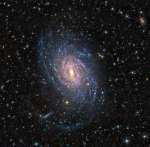 Spiral Galaxy NGC 6744
8.08.2014
Big, beautiful spiral galaxy NGC 6744 is nearly 175,000 light-years across, larger than our own Milky Way. It lies some 30 million light-years distant in the southern constellation Pavo. We see the disk of the nearby island universe tilted towards our line of sight.
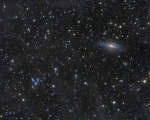 Galaxies in Pegasus
23.10.2014
This wide, sharp telescopic view reveals galaxies scattered beyond the stars and faint dust nebulae of the Milky Way at the northern boundary of the high-flying constellation Pegasus. Prominent at the upper right is NGC 7331.
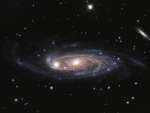 Rubin s Galaxy
25.01.2020
In this Hubble Space Telescope image the bright, spiky stars lie in the foreground toward the heroic northern constellation Perseus and well within our own Milky Way galaxy. In sharp focus beyond is UGC 2885, a giant spiral galaxy about 232 million light-years distant.
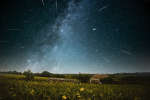 Three Perseid Nights
20.08.2021
Frames from a camera that spent three moonless nights under the stars create this composite night skyscape. They were recorded during August 11-13 while planet Earth was sweeping through the dusty trail of comet Swift-Tuttle.
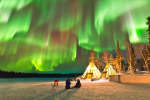 Auroras over Northern Canada
9.10.2022
Gusting solar winds and blasts of charged particles from the Sun resulted in several rewarding nights of auroras back in 2014 December, near the peak of the last 11-year solar cycle. The featured image captured dramatic auroras stretching across a sky near the town of Yellowknife in northern Canada.
 NGC 1360: The Robin's Egg Nebula
5.08.2023
This pretty nebula lies some 1,500 light-years away, its shape and color in this telescopic view reminiscent of a robin's egg. The cosmic cloud spans about 3 light-years, nestled securely within the boundaries of the southern constellation Fornax. Recognized as a planetary nebula, egg-shaped NGC 1360 doesn't represent a beginning though.
|
January February March April May June July August September October |
|||||||||||||||||||||||||||||||||||||||||||||||||