
|
You entered: constellation
 Arp 93: A Cosmic Embrace
16.08.2023
Locked in a cosmic embrace, two large galaxies are merging at the center of this sharp telescopic field of view. The interacting system cataloged as Arp 93 is some 200 million light-years distant toward the constellation Aquarius in planet Earth's sky. Individually the galaxies are identified as NGC 7285 (right) and NGC 7284.
 Barred Spiral Galaxy NGC 5335
26.04.2025
This stunning portrait of NGC 5335 was captured by the Hubble Space Telescope. Some 170,000 light-years across and over 200 million light-years away toward the constellation Virgo, the magnificent spiral galaxy is seen face-on in Hubble's view.
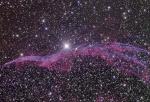 NGC 6960: The Witch's Broom Nebula
1.01.2003
Ten thousand years ago, before the dawn of recorded human history, a new light must suddenly have appeared in the night sky and faded after a few weeks. Today we know this light was an exploding star and record the colorful expanding cloud as the Veil Nebula.
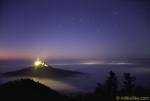 Big Dipper Castle
18.02.2005
The stars of the big dipper, a well known asterism in the constellation Ursa Major, are easy to recognize in this dramatic skyscape. In fact, northern hemisphere skygazers often follow along the line indicated by the two stars at the far right.
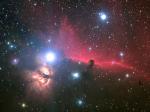 Orions Horsehead Nebula
21.03.2005
The Horsehead Nebula is one of the most famous nebulae on the sky. It is visible as the dark indentation to the red emission nebula seen above and to the right of center in the above photograph. The bright star on the left is located in the belt of the familiar constellation of Orion.
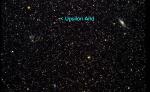 Where is Upsilon Andromedae
22.04.1999
Astronomers recently announced the detection of three large planets orbiting the star Upsilon Andromedae - the first planetary system known to orbit a normal star other than our Sun. These planets were not directly photographed but found through a Doppler technique developed to use large telescopes to search nearby stars for wobbling planetary signatures.
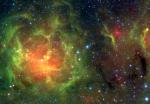 Infrared Trifid
7.07.2007
The Trifid Nebula, aka Messier 20, is easy to find with a small telescope, a well known stop in the nebula rich constellation Sagittarius. But where visible light pictures show the nebula divided into three parts by dark, obscuring dust lanes, this penetrating infrared image reveals filaments of glowing dust clouds and newborn stars.
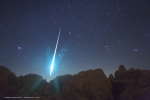 Mojave Desert Fireball
17.12.2009
Monstrously bright, this fireball meteor lit up the Mojave Desert sky Monday morning, part of this year's impressive Geminid meteor shower. Seen toward the southwest over rock formations near Victorville, California, a more familiar celestial background was momentarily washed out by the meteor's flash.
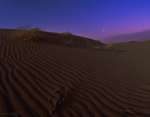 Brighter Than Mars
27.08.2010
Even though you may have just read an email claiming Mars will be incredibly bright tonight, the brightest star on the horizon is not Mars. From central Iran on August 24th, the brightest star in this twilight desert skyview is Venus, aka the Evening Star.
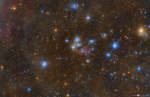 NGC 2170: Celestial Still Life
6.03.2012
Is this a painting or a photograph? In this beautiful celestial still life composed with a cosmic brush, dusty nebula NGC 2170 shines near the image center. Reflecting the light of nearby hot stars...
|
January February March April May June July August September October |
|||||||||||||||||||||||||||||||||||||||||||||||||