
|
You entered: constellation
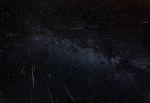 Raining Perseids
20.08.2004
Comet dust rained down on planet Earth last week, streaking through dark skies in the annual Perseid meteor shower. So, while enjoying the anticipated space weather, astronomer Fred Bruenjes recorded a series of many 30 second long exposures spanning about six hours on the night of August 11/12 using a wide angle lens.
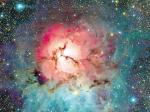 The Trifid Nebula from CFHT
31.05.2005
Unspeakable beauty and unimaginable bedlam can be found together in the Trifid Nebula. Also known as M20, this photogenic nebula is visible with good binoculars towards the constellation of Sagittarius. The energetic processes of star formation create not only the colors but the chaos. The red-glowing gas results from high-energy starlight striking interstellar hydrogen gas.
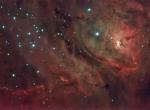 M8: The Lagoon Nebula
10.02.2006
This beautiful cosmic cloud is a popular stop on telescopic tours of the constellation Sagittarius. Eighteenth century cosmic tourist Charles Messier cataloged the bright nebula as M8, while modern day astronomers recognize the Lagoon...
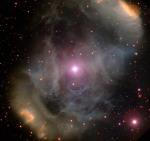 NGC 6164: A Bipolar Emission Nebula
6.06.2006
How did a star form this beautiful nebula? In the middle of emission nebula NGC 6164-5 is an unusually massive star nearing the end of its life. The star, visible in the center...
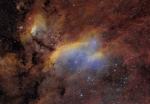 IC 4628: The Prawn Nebula
20.10.2006
South of Antares, in the tail of the nebula-rich constellation Scorpius, lies emission nebula IC 4628. Nearby hot, massive stars, millions of years young, radiate the nebula with invisible ultraviolet light, stripping electrons from atoms. The electrons eventually recombine with the atoms to produce the visible nebular glow.
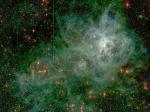 30 Doradus: The Tarantula Nebula
26.10.1999
30 Doradus is an immense star forming region in a nearby galaxy known as the Large Magellanic Cloud. Its spidery appearance is responsible for its popular name, the Tarantula Nebula, except that this tarantula is about 1,000 light-years across, and 165,000 light-years away in the southern constellation Dorado.
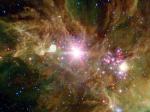 The Snowflake Cluster versus the Cone Nebula
9.05.2007
Strange shapes and textures can be found in the neighborhood of the Cone Nebula. These patterns result from the tumultuous unrest that accompanies the formation of the open cluster of stars known as NGC 2264, the Snowflake cluster.
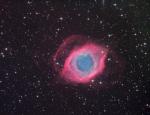 NGC 7293: The Helix Nebula
3.08.2007
A mere seven hundred light years from Earth, in the constellation Aquarius, a sun-like star is dying. Its last few thousand years have produced the Helix Nebula (NGC 7293), a well studied and nearby example of a Planetary Nebula, typical of this final phase of stellar evolution.
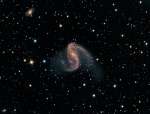 NGC 2442: Galaxy in Volans
28.02.2009
Distorted galaxy NGC 2442 can be found in the southern constellation of the flying fish, (Piscis) Volans. Located about 50 million light-years away, the galaxy's two spiral arms extending from a pronounced central bar give it a hook-shaped appearance.
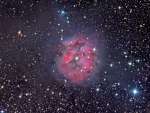 IC 5146: The Cocoon Nebula
5.03.2009
Inside the Cocoon Nebula is a newly developing cluster of stars. Cataloged as IC 5146, the beautiful nebula is nearly 15 light-years wide, located some 4,000 light years away toward the northern constellation Cygnus.
|
January February March April May June July August September October |
|||||||||||||||||||||||||||||||||||||||||||||||||